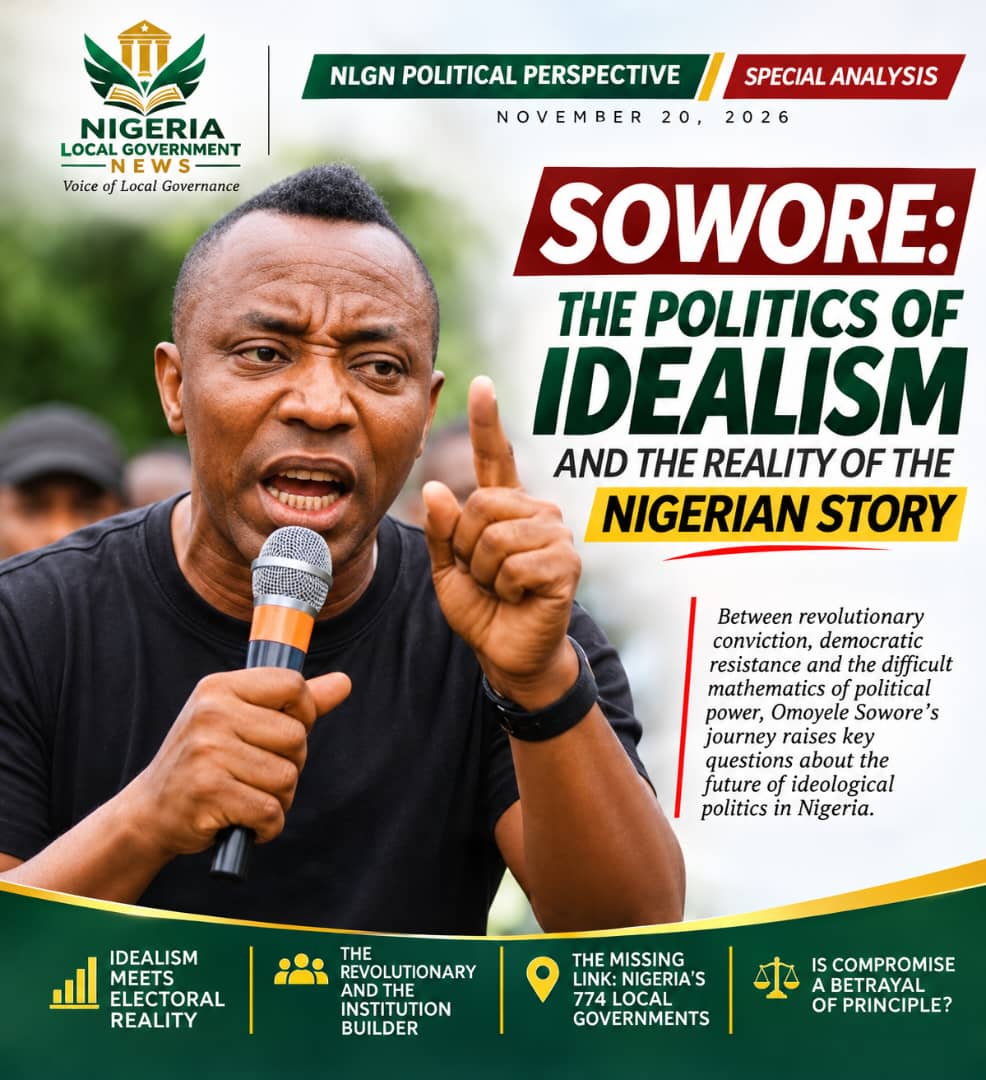
Between revolutionary conviction, democratic resistance and the difficult mathematics of political power, Omoyele Sowore’s political journey raises fundamental questions about the future of ideological politics in Nigeria.
The Man Who Wants to Change the System
In a country where political survival is frequently associated with compromise, alliances, patronage and access to established power structures, Omoyele Sowore represents a different tradition of political engagement.
The journalist, activist and founder of Sahara Reporters has built his public identity around challenging authority, confronting institutional failures and advocating a fundamental restructuring of Nigeria’s political and economic order.
His political philosophy places considerable emphasis on accountability, social justice, civil liberties, economic redistribution and resistance to entrenched political interests.
Yet the Nigerian political environment presents a fundamental question: Can revolutionary idealism translate into democratic power in a society where elections are shaped by complex political networks, economic inequalities, ethnic considerations and grassroots mobilisation?
Sowore’s political experience provides an important case study.
Idealism Meets Electoral Reality
Nigeria’s democracy presents two distinct challenges for political reformers.
The first is winning the argument about what should change. The second is building the organisation, public confidence and electoral coalition necessary to implement that change.
Sowore’s political message has consistently challenged the legitimacy of established political practices. His campaigns have emphasised systemic change rather than incremental adjustments to existing arrangements.
However, electoral politics requires more than ideological clarity.
It demands party structures, local organisers, polling-unit representation, financial resources, coalition-building and sustained engagement with communities whose immediate priorities may differ from the national political conversation.
For millions of Nigerians, politics is experienced not primarily through ideological debate but through questions of food prices, employment, security, healthcare, education, roads and the availability of basic public services.
This creates an important distinction between the language of revolution and the everyday expectations of democratic governance.
A political movement may articulate a compelling national vision while still confronting the practical difficulty of translating that vision into organised support across Nigeria’s diverse communities.
The Ballot Box Tells Another Story
The contrast between Sowore’s national visibility and his recorded electoral support is striking.
SOWORE’S PRESIDENTIAL ELECTION RESULTS
2019 election
33,953
Votes recorded
2023 election
14,608
Votes recorded
Official INEC results.
These figures raise legitimate questions about the relationship between political visibility, public sympathy and actual electoral mobilisation.
They do not, by themselves, explain why voters made their choices. Sowore also disputed the credibility of the 2023 election and rejected the declared outcome.
Nevertheless, the official figures illustrate a central difficulty confronting ideological political movements: public attention does not automatically become electoral support.
The Revolutionary and the Institution Builder
Sowore’s activism also raises questions about the relationship between protest and institutional change.
His association with the #RevolutionNow movement brought him into direct confrontation with the Nigerian state in 2019. His arrest, detention and prosecution attracted international human-rights scrutiny, including criticism documented by the American Bar Association’s Center for Human Rights.
Supporters regard such confrontations as evidence of his commitment to civil liberties and resistance to state power.
Critics of protest-centred political strategies, however, question how sustained confrontation can be translated into the compromises, administrative structures and legislative processes required to govern a complex federation.
Both perspectives point towards a larger democratic issue.
Protest can draw attention to injustice. Elections determine who receives a mandate to govern. Effective public administration requires an additional set of institutions, skills and accountability mechanisms.
These functions can complement one another, but they are not interchangeable.
The Missing Link: Nigeria’s 774 Local Governments
For Nigeria Local Government News, perhaps the most important dimension of Sowore’s political journey is the question of grassroots political organisation.
Nigeria’s 774 constitutionally recognised local government areas provide a critical geographical framework for understanding how national political ideas encounter local realities.
A reform movement seeking lasting institutional influence must engage questions such as:
- How can political ideas become practical programmes for primary healthcare, basic education and rural infrastructure?
- What structures can sustain citizen participation beyond demonstrations and election campaigns?
- How should local government finances, procurement and service delivery be monitored?
- Can ideological movements accommodate the diverse priorities of Nigeria’s rural and urban communities without abandoning their principles?
These are not questions for Sowore alone. They confront every Nigerian political party and reform movement.
A commitment to national transformation ultimately requires a corresponding vision for the ward, the community and the local government council.
Is Compromise a Betrayal of Principle?
One of the enduring tensions in democratic politics is the relationship between conviction and compromise.
Political alliances may expand representation and make legislative action possible. They may also create pressure to dilute policy commitments.
Similarly, maintaining ideological independence can preserve a movement’s identity while limiting its access to broader electoral coalitions.
For Sowore, the strategic question is not simply whether to compromise, but which forms of cooperation could advance stated policy objectives without undermining core commitments.
This distinction matters because democracy is simultaneously a competition of ideas and a process of negotiation.
The challenge is to determine where principled flexibility ends and political inconsistency begins.
Beyond Sowore: The Nigerian Story
Sowore’s experience reflects a wider tension within Nigeria’s democratic development.
Citizens may demand fundamental change while remaining cautious about unfamiliar political alternatives. They may admire outspoken criticism of government without necessarily supporting the critic as a candidate for executive office.
Likewise, an activist’s contribution to public debate cannot be measured exclusively by election results, just as public visibility cannot substitute for an electoral mandate.
Nigeria’s political development requires room for both institutional reformers and independent voices willing to challenge those institutions.
The strength of a democracy is not determined solely by the people who win elections. It is also shaped by the quality of public debate, the protection of dissent, the accountability of office holders and the ability of citizens to organise peacefully.
Conclusion: Between the Dream and the Democratic Mandate
Omoyele Sowore’s political journey brings into focus one of the central dilemmas of Nigerian democracy: the distance between advocating a different political order and acquiring the democratic authority to establish it.
His activism has generated debates about civil liberties, accountability and the boundaries of state power. His electoral experience raises equally important questions about political organisation, coalition-building and the conversion of public engagement into votes.
Neither dimension should be ignored.
The larger Nigerian story is about how democratic societies reconcile conviction with negotiation, dissent with institution-building, and ambitious promises with measurable improvements in citizens’ lives.
Perhaps the most important question is not whether Nigeria needs idealists or pragmatists. It is how the country’s political system can turn principled ideas into accountable institutions and tangible development.
That question extends far beyond Omoyele Sowore. It reaches every political party, every elected office holder and every one of Nigeria’s 774 local government areas.
— NLGN Political Perspective | Voice of Local Governance
NIGERIA LOCAL GOVERNMENT NEWS (NLGN)
Voice of Local Governance
www.nlgnews.ng