DID YOU KNOW?
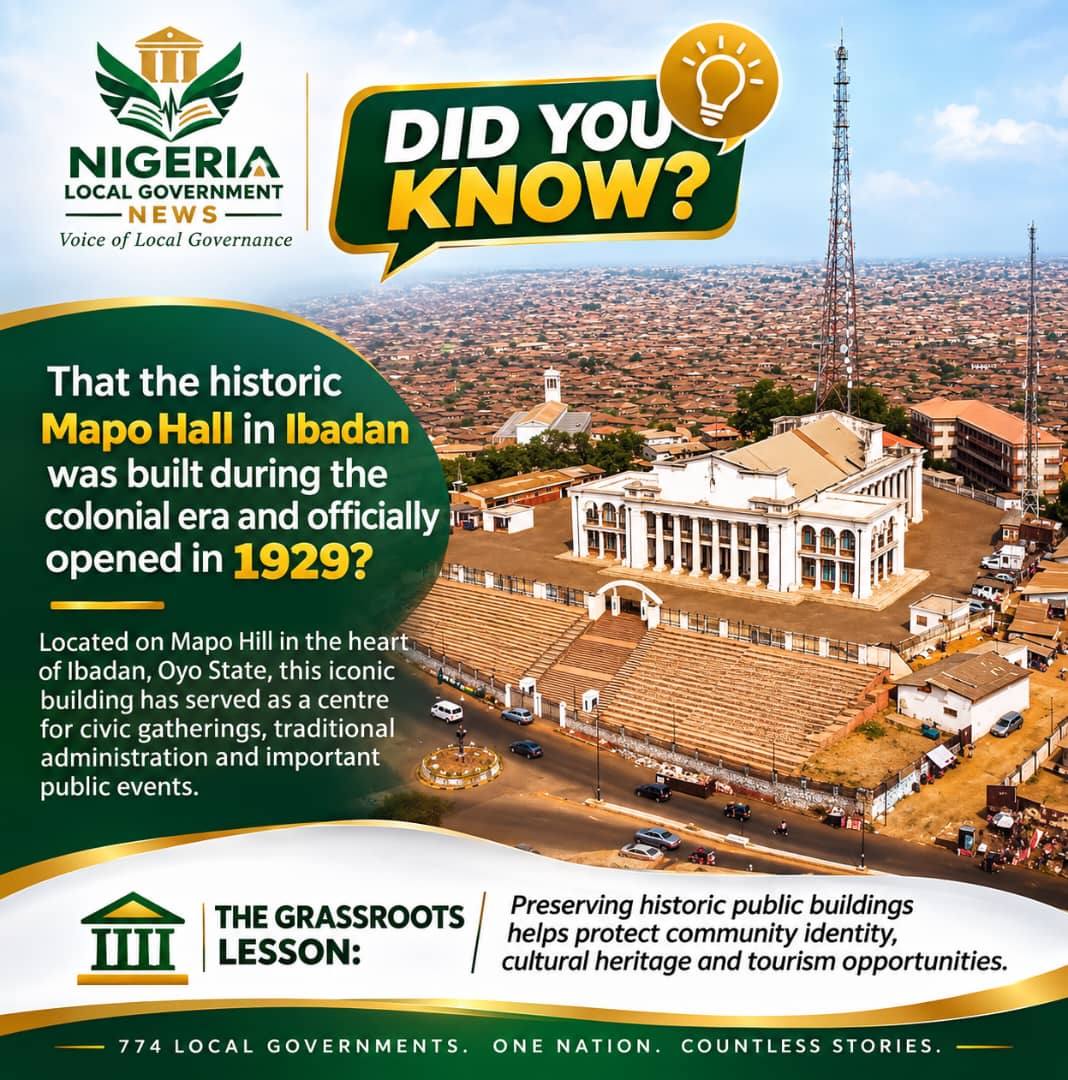
That the historic Mapo Hall in Ibadan was built during the colonial era and officially opened in 1929?
Located on Mapo Hill in the heart of Ibadan, Oyo State, this iconic building has served as a centre for civic gatherings, traditional administration and important public events.
Its commanding position overlooking the old city makes it one of Ibadan’s most recognisable architectural landmarks.
The Story in Brief
Built: 1925–1929
Opened: 1929
Cost: £24,000
Designer and Builder: Engineer Robert A. Jones (1882–1949), known as “Taffy” Jones — a Welsh engineer seconded to the Ibadan Native Authority in 1923 as a road engineer.
Foundation Stone: Laid in June 1925 by Captain W. A. Ross, Resident, Oyo Province.
Declared Open By: Sir Graeme Thomson, Governor of Nigeria, during the traditional leadership of Oba Shiyanbola Ladigbolu, the Alaafin of Oyo, and Oyewole, the Baale of Ibadan.
Style: Neoclassical colonial architecture, modelled after St George’s Hall, Liverpool — a constant reminder of early British influence in the administration of Ibadan as part of Oyo Province.
Famous Feature: Its seven columns, widely said to represent the seven hills upon which the ancient city was built.
Original Role: Administrative headquarters of the Ibadan Native Authority, and the colonial-style Ibadan City Hall.
Today, the compound serves as the administrative headquarters of Ibadan South East Local Government.
A Stage for History
From 1951 onwards, Mapo Hall played host to major political rallies and gatherings that shaped the future of the then Western Region and of Nigeria.
It has hosted civic ceremonies, traditional events, installations, receptions, campaigns and public celebrations — including the installation ceremonies of Olubadan.
In 2006, the hall was renovated. The renovated hall was commissioned by former President Olusegun Obasanjo on 6 September 2007.
Mapo Hall is back in the national spotlight.
Ahead of the APC presidential campaign rally planned for 21 November 2026, the Ibadan Local Governments Properties Company Limited, which manages the facility, initially told the APC that the date was not available because another applicant had booked it earlier.
Governor ‘Seyi Makinde intervened and directed that the Mapo Hall premises be released to the APC, with a suitable alternative venue provided for the earlier applicant.
The Governor said public facilities belong to the people and should be managed transparently and fairly, irrespective of political affiliation, and that no political party should be denied access to public facilities if it meets the established requirements for their use.
It is a reminder that Mapo Hall is not a museum. It is still a living civic space — where the rules for access, fairness and maintenance matter as much as the history.
THE GRASSROOTS LESSON
Preserving historic public buildings helps protect community identity, cultural heritage and tourism opportunities.
But preservation is not just about the building. It is about:
- Maintaining it before it decays
- Managing it transparently, without partisan bias
- Keeping it open to all citizens, parties and communities
- Using it to generate local jobs — guides, events, markets, hospitality
- Telling its story to the next generation
A hall that is only admired is a monument. A hall that is maintained, fairly managed and actively used is a civic asset.
NIGERIA LOCAL GOVERNMENT NEWS (NLGN)
Voice of Local Governance
774 Local Governments. One Nation. Countless Stories.
www.nlgnews.ng