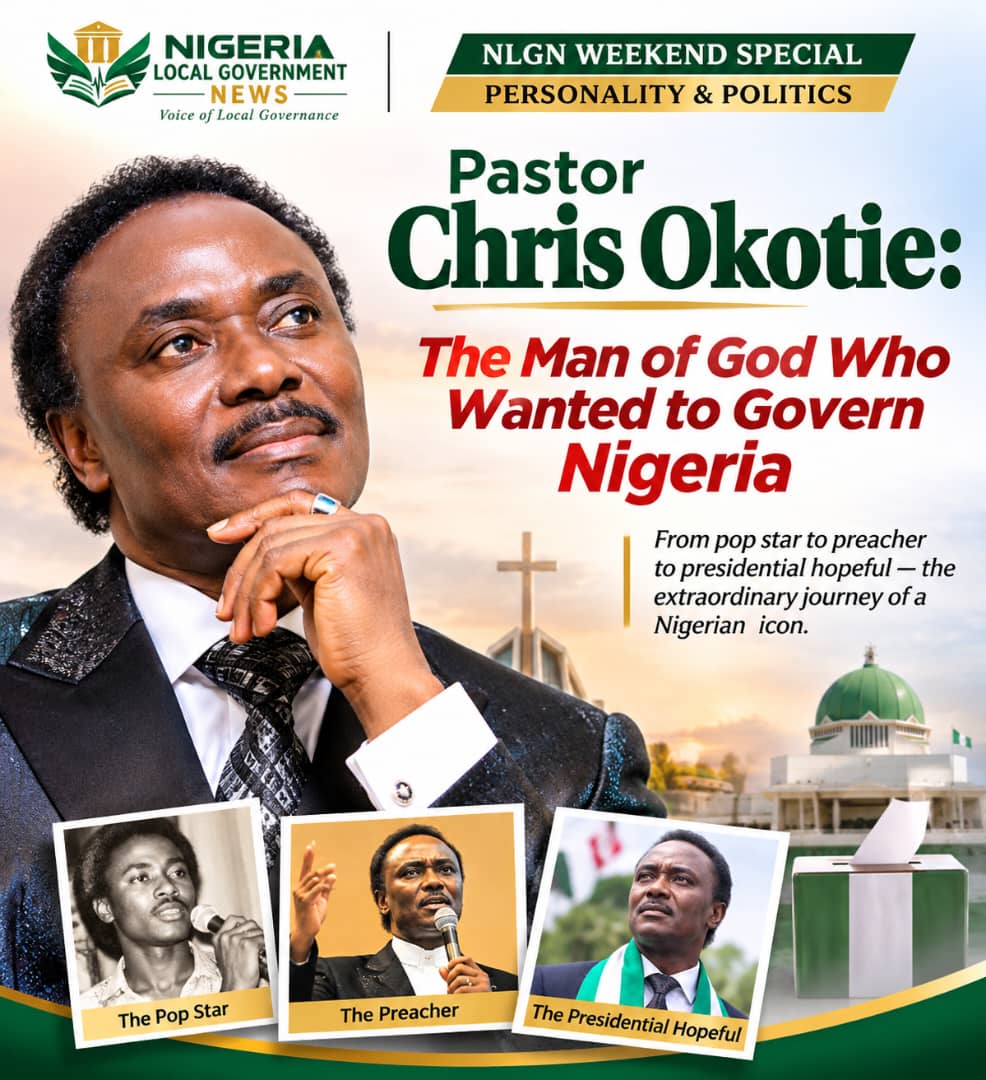
From the glamour of Nigerian pop music to the pulpit of Pentecostal Christianity and the ballot box of presidential politics, the extraordinary story of a man whose ambitions crossed three of Nigeria’s most influential institutions.
By NLGN Features Desk
In the fascinating intersection of religion, entertainment and politics in Nigeria, few personalities have travelled a path quite like Reverend Chris Okotie.
He was a music sensation before becoming a preacher. He became a prominent Pentecostal pastor before venturing into presidential politics. And when his political ambitions failed to translate into electoral victory, he continued to advocate a different vision of how Nigeria should be governed.
For decades, the founder of the Household of God Church International has occupied an unusual place in Nigeria’s public consciousness: a charismatic preacher, a former pop star, a political aspirant and an outspoken advocate of constitutional restructuring.
His story raises an enduring question: Can spiritual influence become political authority in a constitutional democracy?
From pop music to the pulpit
Long before he became known for his elaborate sermons and presidential ambitions, Chris Okotie was a household name in Nigerian entertainment.
Born on June 16, 1958, in Delta State, Okotie attended Edo College, Benin City, and studied law at the University of Nigeria, Nsukka.
His 1980 debut album, I Need Someone, established him as a major figure in Nigeria’s emerging pop music scene.
But in 1984, at the height of his entertainment career, Okotie made a dramatic transition. He abandoned show business, completed his legal education and embraced Christian ministry.
After theological training in Tulsa, Oklahoma, he established the Household of God Fellowship in 1987, which subsequently developed into the Household of God Church International Ministries in Lagos.
It was the beginning of a second public career.
The preacher who entered presidential politics
In 2003, Okotie took another unexpected step.
He announced his intention to become President of the Federal Republic of Nigeria.
Initially associated with the National Democratic Party, he eventually contested the presidential election on the platform of the Justice Party.
His candidature attracted attention partly because of his celebrity status and partly because he presented his political ambition in religious terms.
Okotie maintained that his desire to govern Nigeria was connected to a divine calling.
But the electorate delivered a different result.
OKOTIE’S PRESIDENTIAL ELECTION RECORD
2003
119,547
Votes • Justice Party
2007
74,049
Votes • Fresh Democratic Party
2011
Unsuccessful
Despite these defeats, Okotie remained interested in national leadership.
He established the Fresh Democratic Party as a political platform and continued to argue that Nigeria needed fundamental changes in its system of governance.
His political career demonstrated an important distinction: popularity as a religious leader or entertainer does not automatically translate into electoral support.
When divine conviction meets democratic choice
Perhaps the most intriguing aspect of Okotie’s political journey is the relationship between his religious convictions and the democratic process.
In a country where religious leaders command substantial followings, his presidential campaigns raised questions about the political responsibilities of clergy.
Should a pastor seek elective office?
Can religious conviction provide the foundation for a national political programme?
And how should voters assess a candidate who says his ambition is divinely inspired?
Nigeria’s constitutional democracy allows religious leaders to participate in politics, subject to the same electoral rules as other citizens.
However, political authority ultimately comes from constitutional processes and the electorate, rather than religious standing.
Okotie’s experience illustrates this distinction. His religious profile gave him public visibility, but his presidential campaigns did not secure a significant share of the national vote.
The dream of an interim government
Following his unsuccessful election campaigns, Okotie’s proposals increasingly focused on restructuring Nigeria’s political system.
He advocated what he called Aboriginal Democracy, a proposed alternative framework intended to address what he regarded as fundamental defects in the country’s constitutional arrangements.
In 2022, he publicly proposed an Interim Government of National Reconciliation and Reconstruction, offering himself as its leader.
He argued that Nigeria needed a new constitution and a restructuring process that would address ethnic divisions, perceived marginalisation, corruption and excessive concentration of governmental power.
His proposals also contemplated major changes to existing legislative institutions.
Such proposals, however, raise important constitutional questions.
How would an interim government obtain lawful authority? What would happen to elected institutions? How would Nigerians participate in drafting a replacement constitution?
These questions remain central to evaluating the feasibility of his proposals, regardless of the intentions behind them.
Beyond politics: His contribution to society
To understand Chris Okotie solely through his presidential ambitions would overlook other dimensions of his public life.
Through the Household of God Church, he has supported charitable initiatives and programmes recognising individuals whose contributions to Nigerian society may otherwise receive limited attention.
One example is the church’s KARIS Award, which honours Nigerians for notable contributions to society.
His ministry also identifies partnerships with charitable organisations, including the Sunshine Foundation.
These initiatives reflect a different aspect of Okotie’s public career: his engagement with community welfare and social recognition.
For a publication concerned with grassroots development, this raises a worthwhile question about the relationship between faith-based institutions and local development.
Across Nigeria, religious organisations participate in education, healthcare, welfare and community assistance. Their contributions can complement public services, although they do not replace the constitutional responsibilities of government.
The man who would not abandon his political vision
One remarkable feature of Okotie’s story is the persistence of his interest in political leadership.
He contested presidential elections in 2003, 2007 and 2011. He also secured his party’s presidential nomination ahead of the 2019 election, while continuing to advocate an alternative governance arrangement. Punch Newspapers +1
As recently as March 2026, his presidential ambitions were still being discussed in Nigerian media, although that reporting did not establish a new candidacy for the 2027 election.
His journey therefore remains a study in political aspiration, religious identity and the difficulties of building an electoral constituency beyond an established public following.
The NLGN perspective: Lessons for grassroots democracy
For Nigeria’s 774 local government areas, Okotie’s story offers a useful opportunity to examine the foundations of democratic leadership.
National transformation cannot be measured only by promises from the presidential podium. It must also be evaluated through practical improvements in the communities where citizens live.
Effective local governance requires functioning institutions, accountable public expenditure, citizen participation, accessible healthcare, quality basic education and opportunities for economic development.
Any proposal for national restructuring, including Okotie’s, deserves examination against these practical needs.
Would it strengthen local government autonomy? Would it improve accountability? Would it bring decision-making closer to ordinary Nigerians?
These are questions that extend beyond any individual presidential ambition.
Conclusion: The dream, the calling and the ballot box
Chris Okotie has lived several public lives within one remarkable career.
He has been a pop star, a lawyer, a preacher, a presidential candidate and an advocate of constitutional transformation.
His political aspirations have not resulted in the presidency, but his career remains an interesting chapter in the history of religion and democratic participation in Nigeria.
The larger significance of his story lies in the questions it raises about leadership, personal conviction, political legitimacy and the relationship between spiritual authority and constitutional government.
For Reverend Chris Okotie, the journey from the recording studio to the church pulpit and then to presidential politics has been anything but conventional.
He became a star in music, established a ministry in religion, and sought the highest office in politics. Yet the presidency remained beyond his reach.
And therein lies the enduring fascination of Pastor Chris Okotie: the man of God who wanted to govern Nigeria.