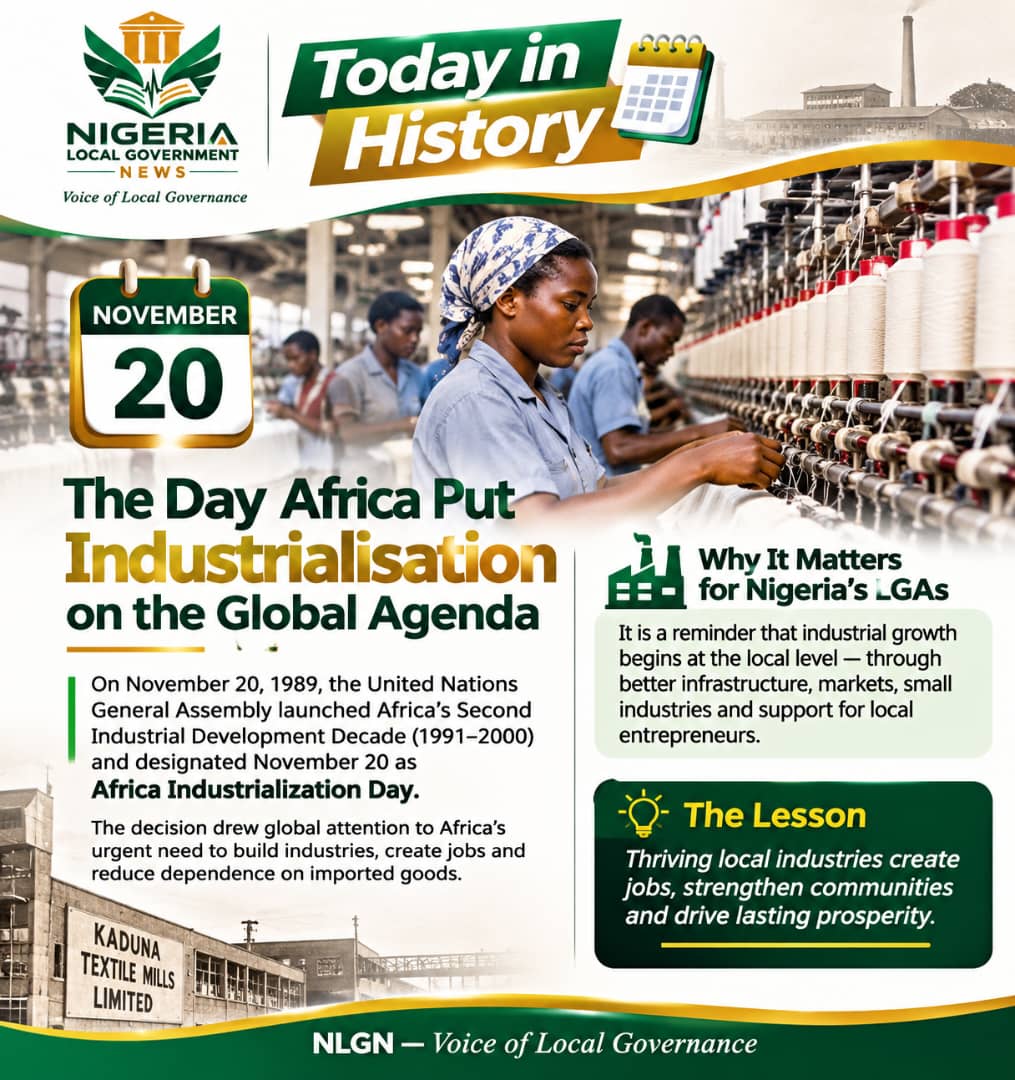
In July 1989, the Organisation of African Unity, at its 25th Ordinary Session in Addis Ababa, announced 20 November as Africa Industrialization Day.
In December 1989, within the framework of the Second Industrial Development Decade for Africa (1991–2000), the United Nations General Assembly proclaimed 20 November as Africa Industrialization Day, in Resolution A/RES/44/237, adopted on 22 December 1989.
The decision drew international attention to Africa’s urgent need to develop industries, create employment and reduce dependence on imported manufactured goods.
For Nigeria, the date evokes memories of an era when industrial centres such as Kaduna, Kano, Lagos, Aba and Nnewi were synonymous with textile production, manufacturing, enterprise and employment.
When Factories Powered Local Communities
In their flourishing years, Nigeria’s textile mills, industrial estates and manufacturing businesses supported thousands of families. Beyond factory wages, they sustained transport operators, food sellers, traders, artisans and surrounding communities.
The lesson remains relevant today: industrial development is not merely about factories. It is about creating prosperity where people live.
Africa Industrialization Day 2026
In 2026, Africa Industrialization Day is being marked as part of Africa Industrialization Week, held in Lusaka, Zambia, from 17–20 November 2026.
2026 Theme: Financing Industrialization for Inclusive and Sustainable Development.
The theme highlights the critical role of financing in driving Africa’s structural transformation, expanding manufacturing capacity, and ensuring that the benefits of industrialization are broadly shared across the continent.
The African Union estimates Africa’s industrial financing gap at USD 280–400 billion annually.
Held on the margins of the Week, the 5th Edition of the African Women in Processing Forum provides a dedicated platform to empower women-led enterprises, strengthen value chain participation, and catalyse partnerships and investment opportunities across the continent.
2026 also marks the start of the Fourth Industrial Development Decade for Africa, proclaimed by the UN General Assembly in May 2026.
In his message for the Day, UN Secretary-General António Guterres said Africa is determined to transform its economies, create productive jobs, transition to clean energy, and build a more prosperous and sustainable future — from electric vehicles and batteries to computer chips and renewable energy — and that realising those opportunities hinges on reliable energy and transport, enabling policy, skills and, above all, financing and investment from the public and private sectors alike.
Why This History Matters to Nigeria’s 774 LGAs
Nigeria’s local governments have an important role in supporting industrial growth through better markets, access roads, sanitation, business-friendly administration and infrastructure.
As Africa marks Industrialization Day in 2026, the historical challenge remains: how can Nigeria transform its agricultural produce, natural resources and entrepreneurial energy into sustainable local jobs?
The answer begins at the grassroots:
- Process what we grow — cassava, cocoa, tomatoes, oil palm, sesame, ginger, groundnuts — in the LGAs where they are grown.
- Power local industry — reliable energy, solar, mini-grids and industrial clusters.
- Build farm-to-market roads, storage, cold chains and standard markets.
- Support MSMEs — registration, credit, skills, cooperatives and women-led processing enterprises.
- Make councils work for business — clear permits, fair levies, clean environments and predictable administration.
Industrialisation does not start in Abuja. It starts in a market in Aba, a processing shed in Idanre, a tomato cluster in Jos East, a textile workshop in Kano, a leather tannery in Sokoto, a food park in Ogun.
NLGN HISTORICAL REFLECTION
The prosperity of a nation begins when its communities become centres of production, enterprise and opportunity.
NIGERIA LOCAL GOVERNMENT NEWS (NLGN)
Voice of Local Governance
www.nlgnews.ng