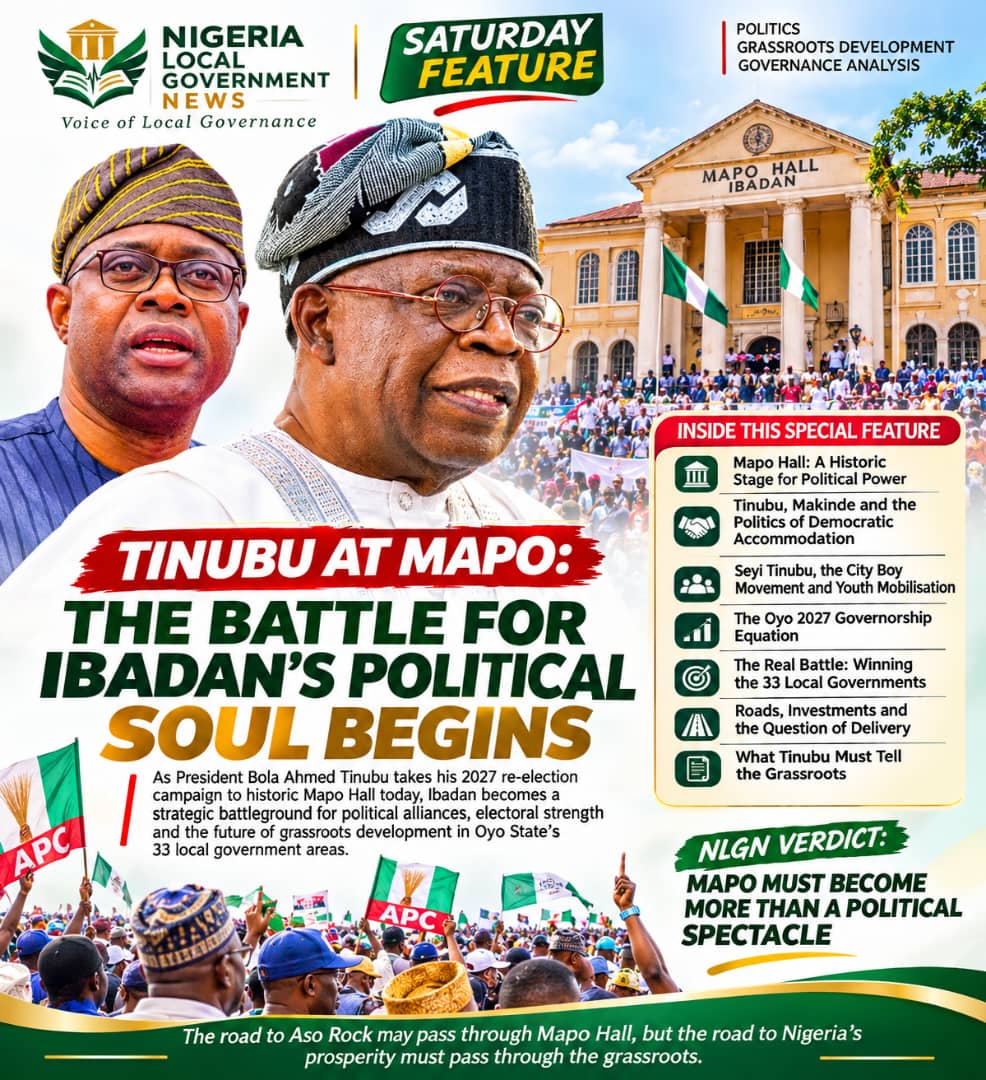
As President Bola Ahmed Tinubu takes his 2027 re-election campaign to historic Mapo Hall, the ancient city of Ibadan becomes a strategic battleground for presidential ambition, political alliances and the future of grassroots development across Oyo State’s 33 local governments.
There are political rallies, and there are political gatherings whose significance extends far beyond the speeches, banners, music and cheering crowds.
Today’s scheduled presidential campaign rally at the historic Mapo Hall in Ibadan belongs to the latter category.
When President Bola Ahmed Tinubu takes his re-election message to the ancient city, he will be entering one of Nigeria’s most politically sophisticated environments — a city where political loyalty is negotiated, power is contested, and electoral victories are rarely secured by presidential influence alone.
For Tinubu, Mapo Hall offers an opportunity to demonstrate the strength of the All Progressives Congress (APC) in the South-West ahead of the 2027 general elections.
For Oyo State’s political establishment, it presents another opportunity to measure alliances, test organisational strength and position competing interests for the approaching governorship contest.
For ordinary residents, particularly those living across the state’s 33 local government areas, however, the more important question is considerably simpler:
What will the President’s campaign mean for jobs, roads, markets, agriculture, public services and the everyday prosperity of communities?
That is the question Nigeria Local Government News believes should remain at the centre of today’s political spectacle.
Mapo Hall: A Historic Stage for Political Power
Mapo Hall is no ordinary campaign venue.
Standing prominently on Mapo Hill, overlooking the commercial heart of Ibadan, the historic building has long represented civic authority, public assembly and the political identity of one of Africa’s great indigenous cities.
Built between 1925 and 1929 and opened in 1929, it has hosted civic ceremonies, traditional events, installations, campaigns and public celebrations for nearly a century.
Its symbolic importance makes it an attractive destination for politicians seeking legitimacy and public visibility.
The choice of Mapo Hall therefore carries a message beyond the logistical convenience of gathering thousands of supporters. It places Tinubu’s presidential ambition against the backdrop of Ibadan’s political history.
But history also teaches an important lesson: Ibadan’s electorate cannot simply be taken for granted.
Political influence in the city has historically depended on a complex relationship involving traditional institutions, community organisations, traders, professional associations, political parties and influential grassroots networks.
A successful rally may demonstrate mobilisation capacity. Whether that enthusiasm translates into votes is an entirely different question.
The Presidential Campaign Comes to the South-West
According to the itinerary reported by THISDAY, President Tinubu is expected to arrive at Ladoke Akintola Airport at approximately 11 a.m., meet traditional rulers from across the South-West, and proceed to Mapo Hall.
The first-class traditional rulers expected to meet with the President include the Ooni of Ife, Olubadan of Ibadanland, Alake of Egbaland, Ewi of Ado Ekiti, Soun of Ogbomoso, Ataoja of Osogbo, Olu of Ilaro and Timi of Ede, among others.
The President is also expected to inaugurate security vehicles procured by the South-West Development Commission before the campaign rally scheduled for 1 p.m.
Vice President Kashim Shettima, APC governors and National Assembly leaders are among the political figures expected to participate. Senate President Godswill Akpabio and House Speaker Tajudeen Abbas are expected to represent the National Assembly leadership.
Today’s rally will mark the seventh state Tinubu will visit in his re-election campaign since the exercise commenced in Kaduna on October 24, 2026. In the revised campaign timetable released earlier this week by the APC Presidential Campaign Council, Tinubu is scheduled to campaign in 19 of the 36 states and the Federal Capital Territory.
The President had earlier campaigned in Uyo, Port Harcourt, Dutse, Jos and Birnin Kebbi, and is scheduled to take the campaign train to 13 other cities between November 25, 2026, and January 13, 2027.
The gathering represents a significant stage in the President’s nationwide re-election campaign.
Yet its deeper significance lies in the political realities of Oyo State.
Unlike Lagos, where Tinubu built much of his political machinery, Oyo has developed its own independent electoral traditions. The state has repeatedly demonstrated that national political influence does not automatically determine local political outcomes.
Consequently, today’s campaign will test more than the President’s popularity. It will test the APC’s ability to translate national visibility into effective ward-level organisation, local political cooperation and voter confidence.
Tinubu, Makinde and the Politics of Democratic Accommodation
One of the most interesting dimensions of today’s rally is the political relationship between President Tinubu and Oyo State Governor Seyi Makinde.
Both occupy influential positions in Nigerian politics, but they operate from different partisan platforms. Tinubu leads the APC-controlled Federal Government, while Makinde’s political career and administration have been associated with the Peoples Democratic Party (PDP), until recently when it was no longer at ease for him and his followers and had to move to seek their electoral fortune at the Allied Peoples Movement (APM) where he is currently contesting for the presidency.
The decision to permit the APC’s proposed use of Mapo Hall has therefore attracted considerable attention.
Governor Makinde directed the release of the Mapo Hall premises to the APC, with a suitable alternative venue provided for an earlier applicant, and publicly affirmed that political parties should have fair access to government-owned facilities, subject to established procedures.
His position was that public assets should not be administered on partisan grounds.
This position deserves recognition as an important democratic principle. Political competition should not prevent public institutions from serving citizens equally.
At the same time, today’s gathering will inevitably be interpreted through the lens of the broader political relationship between Abuja and Agodi.
Will the rally deepen political cooperation between federal and state actors? Will it intensify competition for control of Oyo State? Or will it simply reinforce the reality that political rivals can maintain institutional civility without surrendering their partisan interests?
These questions will remain relevant long after the campaign banners have disappeared.
Seyi Tinubu, the City Boy Movement and the New Youth Mobilisation
The political excitement surrounding today’s rally began before the President’s scheduled arrival.
On Friday, November 20, the City Boy Movement organised a youth walk and concert at the Ibadan Recreation Club, opposite Adamasingba Stadium.
The programme attracted supporters and featured Seyi Tinubu, the President’s son and Grand Patron of the movement. Popular musicians including Saheed Osupa, Qdot and Sean Tizzle performed at the gathering, combining entertainment with political mobilisation.
Seyi Tinubu also visited the Olubadan of Ibadanland, Oba Rashidi Adewolu Ladoja, at his palace.
These activities illustrate how political campaigns are increasingly incorporating youth culture, entertainment and community engagement.
However, they also raise an important question.
Can political movements convert youthful enthusiasm into sustained civic participation and tangible economic opportunities?
For Nigeria’s young people, political engagement must eventually produce more than rallies and concerts. It should create platforms for entrepreneurship, technical training, employment, digital innovation and participation in local governance.
The real measure of successful youth mobilisation is not merely the number of people who attend political events, but the number whose lives improve through better public policies.
The Oyo 2027 Governorship Equation
Today’s presidential campaign is unfolding at a particularly sensitive moment in Oyo State politics.
The governorship race is already attracting considerable attention, with candidates from different political platforms positioning themselves for the 2027 election.
Among those identified in the recent Central Council of Ibadan Indigenes (CCII) peace-accord initiative are Sharafadeen Alli of the APC, Bimbo Adekanmbi of the APM, Oriyomi Hamzat of Accord, Taofeek Adegoke of the ADC, Hazeem Gbolarumi of the PDP and Saheed Oladele of the AAC.
This diversity of political choices makes Oyo an especially interesting electoral environment.
Tinubu’s campaign may strengthen the APC’s organisational visibility, but the presidential and governorship contests are distinct. Voters may support one political party at the national level and another at the state level.
Such electoral independence has become an increasingly important feature of Nigerian politics. It means that political leaders must build confidence around candidates, competence, programmes and performance rather than relying exclusively on party labels.
The CCII’s recent initiative to encourage peaceful, issue-based campaigning also provides a useful counterbalance to the excitement surrounding high-profile political rallies.
For NLGN, the development is significant: community institutions can help shift electoral competition away from personality contests and towards measurable governance commitments.
The Real Battle: Winning the 33 Local Governments
Oyo State at a Glance
Local Government Areas- 33
Senatorial Districts- 3
Electoral Wards – 351
For a publication committed to the development of Nigeria’s 774 local government areas, the most important dimension of today’s rally lies outside Mapo Hall itself. It lies in the communities where voters live and work.
From Ibadan North to Ibarapa East, from Ogbomoso North to Oorelope, from Iseyin to Saki West, political promises must ultimately be measured against the realities of grassroots development.
The farmer in Ibarapa wants affordable inputs, reliable rural roads and profitable access to markets.
The trader in Bodija wants stable purchasing power, improved infrastructure and a business environment that supports growth.
The young graduate in Ogbomoso wants employment and access to opportunities.
The small-business owner in Saki wants electricity, credit and improved connectivity.
And the resident of a rural community wants functional primary healthcare, safe water and schools that deliver quality education.
These expectations cannot be satisfied by political symbolism alone. They require practical programmes, reliable financing, effective institutions and accountable implementation.
Roads, Investments and the Question of Delivery
Supporters of the President have highlighted several federal road projects associated with Oyo State, including the Ilorin–Ogbomoso corridor, the Iseyin–Eruwa–Agbesi Road and the Idi-Araba–Ayede–Olodo Road.
Reports have cited substantial funding approvals for these projects as evidence of federal infrastructure commitments.
However, project approvals, actual disbursements, construction progress and completed infrastructure are different stages of delivery.
For grassroots communities, what matters is whether these investments eventually reduce travel times, improve farm-to-market access, lower transport costs and stimulate local enterprise.
This distinction is essential. A road project becomes a development achievement when it delivers measurable benefits to the people it was designed to serve.
The same principle applies to agriculture, education, healthcare, housing, youth employment and local government finance.
What Tinubu Must Tell the Grassroots
The President’s appearance at Mapo Hall provides an opportunity to explain how his administration intends to strengthen development at the local government level.
Five questions deserve particular attention:
- Local government autonomy: How will the Federal Government ensure that constitutional and judicial commitments to local government financial independence translate into practical improvements?
- Rural economic development: What specific initiatives will support agricultural communities, rural enterprises and small businesses?
- Youth employment: How will national programmes create sustainable jobs across local government areas rather than concentrating opportunities in major cities?
- Infrastructure delivery: What measurable progress has been achieved on federal projects affecting Oyo State, and what completion timelines can citizens reasonably expect?
- Public accountability: How will citizens track the implementation and impact of government programmes in their communities?
These are not questions for the President alone. They are questions for every political party, every governorship candidate, every legislator and every local government chairman seeking public trust.
The Morning After Mapo: What NLGN Will Be Watching
Political rallies are powerful instruments of democratic communication. They allow political leaders to present their vision, energise supporters and demonstrate organisational capacity.
But rallies are not elections. Crowds are not automatically votes. And campaign promises are not automatically development achievements.
The real test begins when the speeches end.
NLGN will be watching:
- Whether the campaign remains peaceful, and whether all parties retain fair access to public facilities
- Whether reports of cash distribution and alleged billboard vandalism ahead of the rally are investigated transparently, without reprisal or partisan bias
- Whether federal road and security commitments in Oyo State move from approval to visible delivery
- Whether youth mobilisation translates into jobs, skills and participation in local governance
- Whether the CCII peace accord holds, and whether the governorship contest stays issue-based.
NLGN Verdict: Mapo Must Become More Than a Political Spectacle
President Tinubu’s scheduled appearance in Ibadan represents an important moment in the emerging 2027 political contest.
It provides an opportunity for the APC to consolidate support, for political stakeholders to reassess alliances and for citizens to examine competing visions of leadership.
Yet the enduring significance of the rally will not be determined by the size of the crowd or the prominence of the dignitaries. It will be determined by what follows.
For Nigeria Local Government News, the fundamental principle remains unchanged:
Nigeria’s development must begin where its people live — in the 774 local government areas.
The future of the country cannot be secured through presidential politics alone. It requires strong local institutions, productive communities, accountable leadership and inclusive economic opportunities.
As the campaign spotlight turns towards historic Mapo Hall, one message deserves to rise above the political excitement:
The road to Aso Rock may pass through Mapo Hall, but the road to Nigeria’s prosperity must pass through the grassroots.
And that is where the real campaign for national development must be won.