Thousands welcome former Anambra governor in a homecoming that combines political mobilisation, grassroots enthusiasm and renewed promises on education, healthcare and electricity.
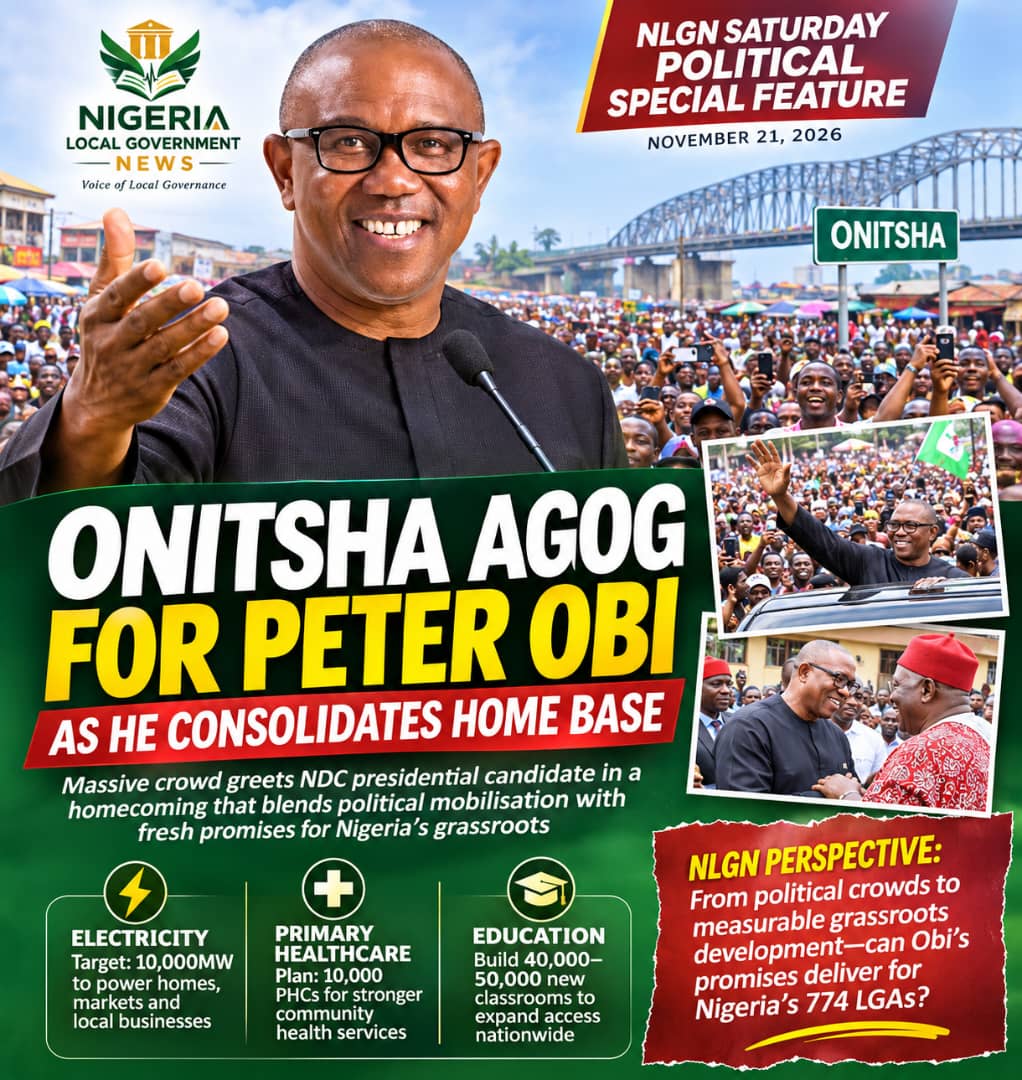
ONITSHA, ANAMBRA STATE — Nigeria’s bustling commercial city of Onitsha witnessed an extraordinary political spectacle on Friday, November 20, 2026, as thousands of residents, traders, youths and political supporters poured onto major streets to welcome former Anambra State Governor and Nigeria Democratic Congress (NDC) presidential candidate, Mr Peter Obi.
What was originally scheduled as a town hall engagement became a major homecoming, with cheering crowds lining roads, waving party flags and accompanying the presidential hopeful through parts of the commercial metropolis.
The procession caused significant traffic congestion around the First Niger Bridge, Onitsha Main Market, Upper Iweka and Awka Road, according to reports by PUNCH and other national newspapers.
A Homecoming with Political Significance
For Obi, Onitsha represents more than another campaign destination.
It is the city where he grew up, attended Christ the King College and established enduring personal and commercial relationships before becoming governor of Anambra State.
His return therefore carried considerable personal and political symbolism.
The presidential candidate visited his alma mater, Christ the King College, where he addressed students and encouraged them to pursue education seriously. He told them the school had produced three governors and could soon produce Nigeria’s president.
From there, his campaign team moved through major streets before proceeding to the town hall venue at the Main Bowl of the Archbishop C.J. Patterson Building, All Saints Cathedral, Onitsha.
The event, chaired by Prof. Oby Orogbu, who represents Awka North and South Federal Constituency in the House of Representatives, attracted traders, students, women, political activists and supporters, some of whom reportedly suspended commercial activities to join the procession.
Crucially, Obi did not arrive alone. His running mate, former Kano State Governor Rabiu Musa Kwankwaso, arrived with him for the town hall — a visible signal that the Obi–Kwankwaso ticket is campaigning as a joint team, not as two separate regional candidacies.
Consolidating the Home Base
Beyond the excitement of the homecoming, Obi’s visit highlights the importance of maintaining an active political organisation in his home state ahead of the 2027 general elections.
The former governor enters the new electoral cycle as the presidential candidate of the NDC, with Kwankwaso as his running mate. He governed Anambra State between 2006 and 2014 and was the Labour Party’s presidential candidate in the 2023 general election.
The Obi–Kwankwaso political partnership brings together two politicians with established public profiles in different parts of the country — the South-East and the North-West.
However, large political gatherings, while demonstrating mobilisation capacity, do not necessarily establish the voting intentions of the wider electorate.
The significant questions now concern how the NDC intends to translate public enthusiasm into durable grassroots structures, polling-unit representation and sustained engagement with communities.
Obi himself addressed that question directly. He urged Nigerians to turn out en masse for the January 16, 2027 presidential election and defend their votes, asking supporters to remain at polling units until votes were counted and transmitted.
“Sacrifice one day for Nigeria. That day of voting.”
“Don’t be afraid of anybody that day. If anybody asks you to leave that polling station, tell him you won’t step out until the result is declared.”
He also urged supporters to vote for NDC candidates in the presidential, senatorial and House of Representatives elections, as well as the subsequent House of Assembly election.
The Grassroots Development Promises
For Nigeria Local Government News, perhaps the most important aspect of Obi’s Onitsha engagement was not the size of the crowd but the development commitments he made.
During the town hall meeting, Obi outlined proposals addressing three critical sectors.
Promise: What Obi Said in Onitsha
Electricity: Generate, transmit and distribute at least 10,000 megawatts within his tenure, up from about 4,000–5,000MW today
Primary Healthcare: Establish 10,000 primary healthcare centres, with a functional centre in every one of Nigeria’s 8,809 wards
Education: Begin construction of 40,000 primary school blocks from Day One, to tackle the out-of-school.
Obi also pledged to tackle kidnapping, corruption and unemployment, to move Nigeria from consumption to production, and to use public money for public good:
“Kwankwaso and I have formed a team that will unite and secure Nigeria. We will secure Nigeria, fight corruption and use public money for public good.”
“We want a country where, when you are sick, you go to hospital and not to church.”
“Take note of everything I said here, we don’t want to make fake promises.”
These proposals deserve particular scrutiny because their implementation would directly affect Nigeria’s 774 local government areas.
Improved primary healthcare could reduce the burden on rural families who currently travel considerable distances for treatment.
Additional classrooms could help address educational infrastructure deficits, while reliable electricity would support small businesses, markets, cottage industries and agricultural processing.
Nevertheless, the financial requirements, implementation timelines and institutional responsibilities for these commitments remain important questions for voters and development stakeholders.
The Grassroots Test: What 10,000 and 40,000 would mean
10,000MW of electricity
Nigeria’s challenge is not generation alone. It is generation, transmission and distribution together. Obi’s promise is explicit on all three. The grassroots test is whether power reaches markets, cold rooms, mills, workshops and rural enterprises — not just major cities.
10,000 primary healthcare centres
Nigeria has 8,809 wards. A promise of 10,000 centres, if delivered, would mean at least one functional centre per ward, with more in larger wards. The grassroots test is staffing, drugs, equipment, water, power and maintenance — not just buildings.
40,000 primary school blocks
With an estimated 18 million out-of-school children, classrooms alone will not solve the crisis. The grassroots test is teachers, learning materials, safe water, toilets, and a maintenance system that keeps classrooms usable after the ribbon-cutting.
NLGN will hold every candidate to the same test: How much? How long? Who pays? Who maintains it? How will citizens verify it?
The Challenge Beyond Anambra
The Onitsha gathering provides evidence of significant enthusiasm among supporters who attended the event.
But presidential politics requires engagement across Nigeria’s six geopolitical zones, involving diverse economic interests, religious communities, ethnic identities and local development priorities.
The Obi–Kwankwaso campaign will consequently face questions about how it intends to build political structures across the country, communicate its policies and address the different expectations of urban and rural communities.
For other presidential contenders, including the incumbent President Bola Tinubu of the APC and former Vice-President Atiku Abubakar of the ADC, the approaching election similarly places attention on records of governance, economic performance and competing policy proposals.
The January 16, 2027 election will be decided not by homecoming crowds alone, but by organisation in 8,809 wards, 774 LGAs and 36 states plus the FCT.
NLGN Perspective: From Political Crowds to Grassroots Dividends
The real significance of the Onitsha homecoming extends beyond political celebration.
It offers another opportunity to examine what presidential aspirants are proposing for the communities where Nigerians live, work, trade, farm and raise their families.
Will primary healthcare centres be properly staffed and equipped? How will additional classrooms be maintained? What arrangements will ensure that electricity improvements reach rural enterprises and local markets?
These are the development questions that should accompany every major political gathering ahead of 2027.
Onitsha has demonstrated the enthusiasm of Peter Obi’s supporters. The next test is how the candidate and his party will translate their campaign commitments into detailed, credible and measurable development programmes.
For Nigeria’s 774 local government areas, that conversation matters as much as the political spectacle itself.
NLGN — Voice of Local Governance