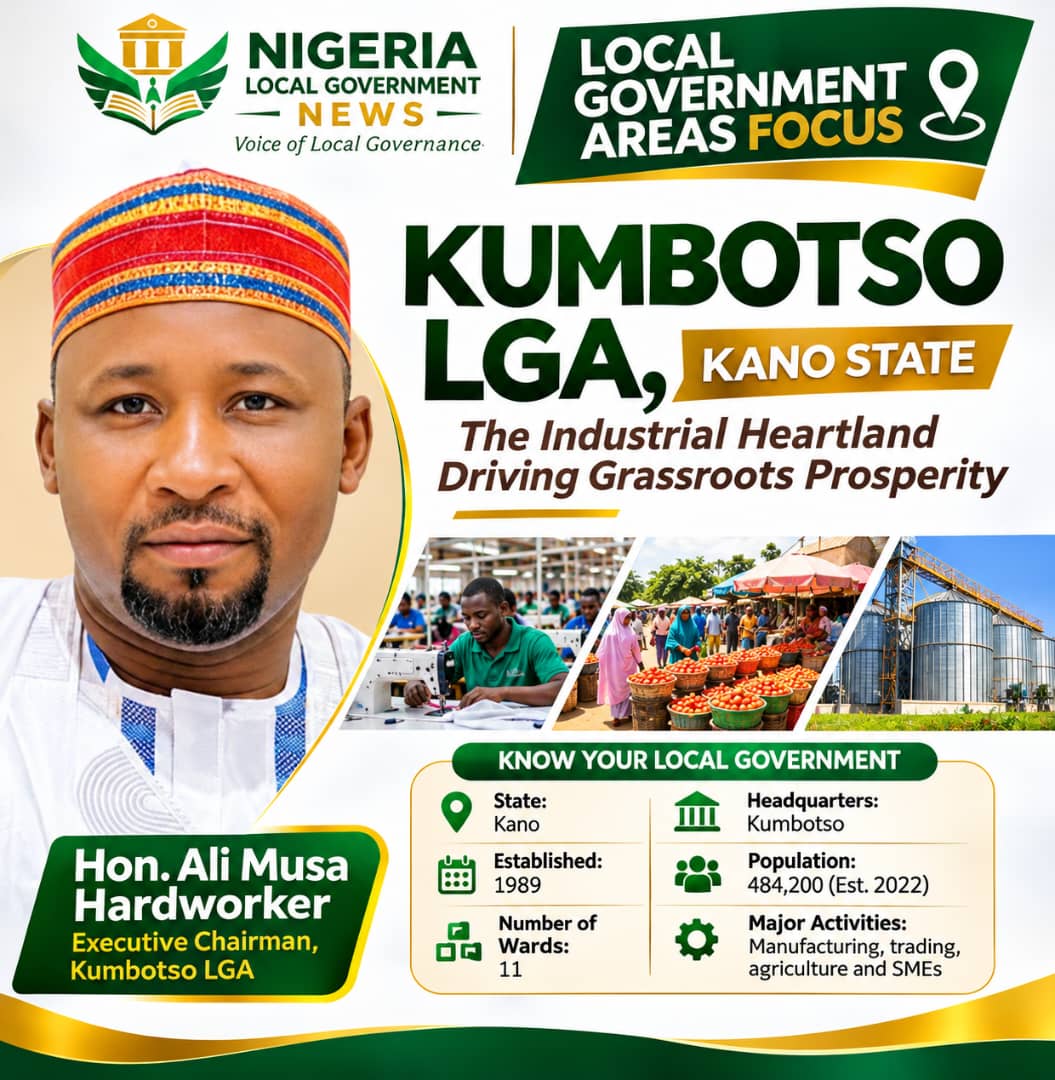
Kumbotso Local Government Area, Kano State
Where enterprise, agriculture and community development meet.
Kumbotso Local Government Area is one of Kano State’s important commercial and industrial communities. Located close to Kano metropolis, it combines manufacturing, trading, small businesses and agricultural activities, making it a compelling example of grassroots economic potential.
Know Your Local Government
Profile Details
Local Government: Kumbotso
State: Kano
Geopolitical Zone: North-West
Headquarters: Kumbotso town
Senatorial District: Kano Central
Area: About 158 km²
Population: 294,391 (2006 Census) — 2006 figure is the last official census. Later projections vary widely, from about 409,500 in 2016 to about 484,200 in 2022. NLGN uses the census figure as the verified baseline.
Wards: 11
Created 1976, from Kano’s old metropolitan structure
The 11 Wards:
Challawa, Chiranchi, Danbare, Danmaliki, Guringawa, Kumbotso, Kureken Sani, Mariri, Na’ibawa, Panshekara, Unguwar Rimi
Kumbotso is one of the eight metropolitan LGAs of Kano City — alongside Dala, Fagge, Gwale, Kano Municipal, Nassarawa, Tarauni and Ungogo.
It is bordered by Gwale to the north, Madobi to the west, Kano Municipal and Tarauni to the east, and Dawakin Kudu and Kura to the south.
Why Kumbotso Matters To Kano
Kano is the largest industrial centre in Northern Nigeria — textiles, tanning, footwear, cosmetics, plastics, enamelware, pharmaceuticals, ceramics and furniture.
Kumbotso sits inside that economy, not outside it:
- Challawa Industrial Estate — Kumbotso is famous for its manufacturing industries at Challawa, a major employer and logistics hub
- Yanlemo Market, Na’ibawa — trades fruit brought in from across the region, a daily grassroots economy in itself
- Agriculture — farmers grow sorghum, rice, beans and onions across the LGA, alongside fish farming (Clarias gariepinus is the most cultured species in local studies)
- Trade and services — transport, warehousing, workshops, retail and informal markets that serve Kano metropolis
This is why NLGN calls it an industrial heartland: it is where factory, farm and market meet in one LGA.
Meet The Executive Chairman
Hon. Ali Musa Danmaliki — popularly known as “Hardworker”
Hon. Ali Musa Hardworker was sworn in as Executive Chairman of Kumbotso Local Government Area on 24 March 2026, following a Kano State High Court judgment.
What actually happened :
- 2024 LGA elections: Abdullahi Ghali Shitu, popularly known as Basaf, was initially declared winner and given a Certificate of Return.
- Legal battle: The case dated back to the 2024 primaries. Ali Musa argued he was the authentic candidate and that his name had been illegally substituted.
- 24 March 2026: Justice Abdu Mai Wada Abubakar of Kano High Court, Court No. 17, nullified Basaf’s Certificate of Return and declared Ali Musa the duly elected chairman. The court directed KANSIEC to issue a Certificate of Return immediately and that Musa be sworn in without delay to prevent a leadership vacuum.
- Same day: KANSIEC Chairman, Prof. Sani Malumfashi, presented the Certificate of Return to Ali Musa.
- Evening of 24 March 2026: Governor Abba Kabir Yusuf swore him in at Government House, Kano, charging him to discharge his duties with honesty, dedication and a strong commitment to grassroots development.
At his inauguration, he pledged to prioritise residents’ welfare and grassroots development.
The NLGN Development Perspective
Kumbotso’s development potential rests on three important pillars:
- Industrial Growth And Employment
Challawa and the wider Kano industrial corridor can create formal jobs, apprenticeships and supply-chain opportunities — if power, water, roads and security are reliable. - Agricultural Productivity
Sorghum, rice, beans, onions and fish farming can feed Kano and supply processors, but farmers need storage, irrigation, extension services and market access — especially at Yanlemo and other local markets. - Youth Entrepreneurship
With appropriate infrastructure, vocational training and support for small businesses, Kumbotso’s young population can move from informal trading to registered enterprises, workshops, logistics and agro-processing.
The Grassroots Challenges
A development feature that only praises industry is incomplete. Research on Kumbotso also shows:
- Groundwater and sanitation risks — groundwater is a primary drinking water source, and studies in 2023–2025 found hygiene and contamination risks in wells and boreholes
- Rapid population growth — from 294,391 in 2006 to a projected 400,000+ today, putting pressure on schools, clinics, roads and waste management
- Flooding and drainage — a common Kano metropolitan challenge, especially in low-lying wards
- Industrial pollution — a risk where manufacturing, residential areas and water sources sit close together
Prosperity in Kumbotso will be measured not only by factory output, but by clean water, safe roads and healthy communities.
NLGN’s Question
How can Kumbotso translate its industrial and commercial advantages into better roads, improved public services and sustainable jobs for its residents?
For Kumbotso, the answer must include:
- Industrial estates that employ local youth, not just truck drivers passing through
- Markets like Yanlemo with clean water, toilets, cold storage and safe access
- Vocational centres that train welders, electricians, mechanics, agro-processors and ICT technicians
- A council that publishes its budget, projects and contracts — so residents can track promises
NIGERIA LOCAL GOVERNMENT NEWS (NLGN)
Voice of Local Governance
www.nlgnews.ng