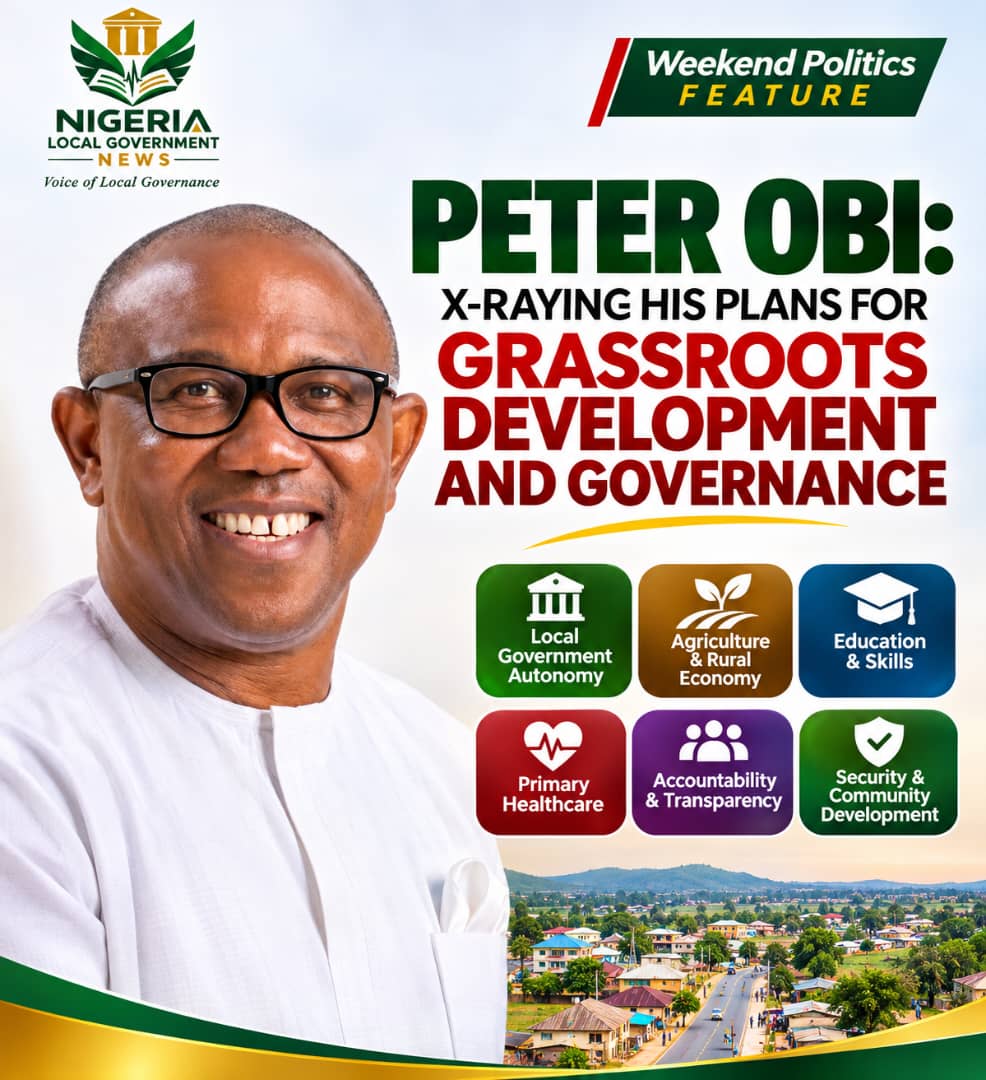
Peter Obi
The Grassroots Question
Can his vision for a productive Nigeria transform the fortunes of 774 local government areas?
Beyond the promise of a new Nigeria, what does Peter Obi’s development agenda mean for the country’s 774 local government areas, rural communities, farmers, small businesses and ordinary citizens?
As Nigeria approaches the 2027 general elections — presidential election scheduled for 16 January 2027 — former Anambra State Governor and Nigeria Democratic Congress (NDC) presidential candidate, Peter Obi, is once again presenting a vision of governance built around economic productivity, institutional reform, public accountability and investment in human capital.
- Obi was Labour Party candidate in 2023, finishing third with about 6.1 million votes. He left Labour Party, joined the ADC coalition on 31 December 2025, then left ADC with Rabiu Kwankwaso in May 2026 for the NDC, where Obi was adopted as presidential candidate with Kwankwaso as his running mate. Atiku Abubakar remained in ADC and won its primary — though that primary was later nullified by a Federal High Court judgment on 5 November 2026, now under appeal.
But for millions of Nigerians living outside the major cities, the important question is not simply who occupies Aso Rock. It is whether a change in national leadership would translate into better roads, functioning primary healthcare centres, improved public schools, agricultural opportunities and more effective local government administration.
Nigeria Local Government News (NLGN) examines Obi’s documented proposals, his recent pronouncements and the practical questions surrounding their implementation.
- Local Government Autonomy: Returning Power To The Grassroots
One of Obi’s previously stated positions is that local government authorities should enjoy greater independence in shaping and implementing public policies.
In his earlier presidential policy statements, he specifically advocated empowering Nigeria’s 774 local government areas to deliver public services and infrastructure. His 2023 manifesto also proposed reforms that would enable the three tiers of government to function independently while cooperating on national development.
For NLGN, the important questions are how Obi would implement the Supreme Court’s July 2024 local government autonomy judgment, protect council finances from interference and strengthen democratic accountability at the council level.
Financial autonomy alone does not guarantee effective governance. Local councils would also need transparent budgets, procurement systems, competent personnel and mechanisms through which citizens can monitor spending.
NLGN test: Will Obi commit to a published implementation plan — with dates — for direct allocation, audited accounts, and sanctions for governors who divert council funds?
- From Consumption To Production: Reviving Rural Economies
Perhaps the most recognisable element of Obi’s economic philosophy is his proposed transition from consumption to production.
His policy agenda emphasises agriculture, manufacturing, small businesses, affordable financing and productive employment.
For grassroots communities, this could mean greater attention to:
- Agricultural processing and rural value chains
- Financing for small and medium-sized enterprises
- Rural roads, storage facilities and market access
- Employment opportunities for women and young people
His earlier manifesto particularly emphasised agricultural development in Northern Nigeria.
However, an important implementation question remains: what specific responsibilities, funding and institutional support would local governments receive under such a programme?
NLGN test: How much — in naira, per LGA, per year — would go to rural roads, storage, extension services and SME credit? Who decides, and who audits?
- Education And Healthcare: Development Begins In The Community
Obi has repeatedly identified education and healthcare as essential foundations for economic transformation.
During his 10 November 2026 town hall in Jos, Plateau State, he reiterated the importance of functional primary healthcare centres and improved access to education, particularly for disadvantaged communities.
He also raised concerns about preventable maternal and infant deaths, poverty and the number of children outside the school system.
At Jos, Obi said:
“Today, if you are sick in Nigeria, you go to church because there are no functional hospitals in many communities. The consequence is that people are dying. Pregnant mothers are dying, children are dying, and we have very high infant and maternal mortality rates.”
“The foundation of access to healthcare is primary healthcare. We must strengthen our primary healthcare centres and ensure that every community has access to quality medical services.”
He cited an estimated 18 million out-of-school children, and promised more classrooms, more teachers and better quality public education. He also visited the Plateau State Traditional Council, meeting Gbong Gwom Jos, Da Jacob Gyang Buba, and recalled visits to Bokkos, Barkin Ladi and Mangu.
For local governments, these proposals raise measurable expectations: adequately staffed health centres, functioning schools, better learning outcomes and affordable essential medical services.
The test would be whether these priorities are backed by identifiable budgets, implementation deadlines and clear responsibilities across federal, state and local authorities.
NLGN test: How many PHCs per ward would be staffed and equipped in Year 1? What is the teacher recruitment target? What is the out-of-school reduction target by 2031?
- Governance And Accountability: Making Public Money Work
Obi’s proposals include reducing wasteful expenditure, strengthening anti-corruption institutions, promoting transparent procurement and expanding technology-driven public services.
These commitments are particularly relevant to local governments, where citizens often struggle to obtain information about budgets, statutory allocations and completed projects.
The need for transparency has gained renewed attention. On 12 November 2026— the ICPC and NITDA launched the ICPC-NITDA Local Government Websites Pilot in Lafia, Nasarawa State.
ICPC Chairman Dr Musa Adamu Aliyu disclosed that ICPC had recovered over ₦5.3 billion after reviewing council accounts in seven states and the FCT. NITDA pledged to register domains, develop and host websites for all 774 LGAs for at least one year. Councils would be expected to publish budgets, allocations, revenue, expenditure, audits, debts, procurement, HR, whistleblowing channels and citizen-engagement information.
A key question for Obi is whether his proposed governance reforms would establish enforceable public disclosure standards for all 774 councils.
NLGN test: Would every council be required by law to publish allocations, contracts and expenditure — with penalties for non-publication?
- Security And Community Development
During his recent engagements in Plateau State, Obi argued that meaningful national development requires improved security and greater responsiveness to communities affected by violence.
He advocated stronger security institutions and policies addressing the economic and social conditions that contribute to insecurity.
At Jos, he said:
“If I have one person in an IDP camp, it means we are all in an IDP camp. I am competing because I want to know how we talk to that mother whose child was killed, that husband who lost a wife and that woman who lost a husband.”
He promised safe return for displaced families, and said children must return safely from school, farmers from farms, traders from markets.
For grassroots governance, the issues extend beyond policing to restoring livelihoods, supporting displaced communities and making rural areas safe for agriculture, commerce and education.
The details of how federal security agencies, state governments and local institutions would coordinate remain important questions for further scrutiny.
NLGN test: What is Obi’s specific plan for state policing, community policing, forest guards, and coordination with governors — not just “strengthen security architecture”?
- The Other Side: What Critics Say
The counter-arguments,:
- Anambra record is contested. Supporters cite fiscal prudence, savings, and education/health investments during his 2006–2014 governorship. Critics — including President Tinubu in Akwa Ibom on 6 November 2026 — accuse him of failing to tackle erosion and other infrastructure problems in Anambra.
- One-term pledge is contested. Obi has said he would serve only one term if elected. Critics, including commentators in November 2026, argue no president can turn Nigeria around in one term, and question whether the pledge is realistic or enforceable.
- Party instability. Obi has moved from Labour Party → ADC → NDC in less than a year. Supporters say this reflects opposition coalition crisis. Critics say it raises questions about party-building and stability.
- Opposition division. Sule Lamido and others argue that Obi and Atiku splitting the opposition vote hands Tinubu an advantage — the same dynamic as 2023.
- Manifesto gap. As of November 2026, Obi has outlined priorities at town halls, but NLGN has not seen a final, costed 2027 NDC manifesto with LGA-specific funding. That is the document voters should demand.
NLGN does not endorse any candidate. We test all candidates against the same grassroots questions.
- The Unanswered Questions
Although Obi’s policy direction is documented, several important issues require more detailed answers before its implications for local governments can be fully assessed.
- Autonomy: What specific constitutional and administrative reforms would protect elected local government councils?
- Funding: How much additional investment would be directed towards grassroots infrastructure and public services?
- Accountability: Would every council be required to publish allocations, contracts and expenditure?
- Implementation: What measurable development targets would be established for the first four years?
- Federalism: How would the administration address state-level resistance to greater local government independence?
- Security: What is the costed plan for returning IDPs in Plateau, Benue, Borno, Zamfara and other states?
- One term: If he serves only one term, what can realistically be delivered in four years, and what happens after?
NLGN Perspective: Beyond Promises, Towards Measurable Development
The grassroots dimension of Peter Obi’s political agenda deserves examination because several of his stated priorities — agriculture, education, healthcare, public accountability and local government independence — directly concern everyday life in Nigeria’s communities.
However, policy commitments must be distinguished from funded programmes and implemented outcomes.
As the 2027 presidential contest develops, NLGN will continue examining the proposals of presidential candidates against the practical needs of Nigeria’s 774 local government areas.
The central question remains: How will national political promises translate into measurable improvements in grassroots governance and development?
NIGERIA LOCAL GOVERNMENT NEWS (NLGN)
Voice of Local Governance
www.nlgnews.ng