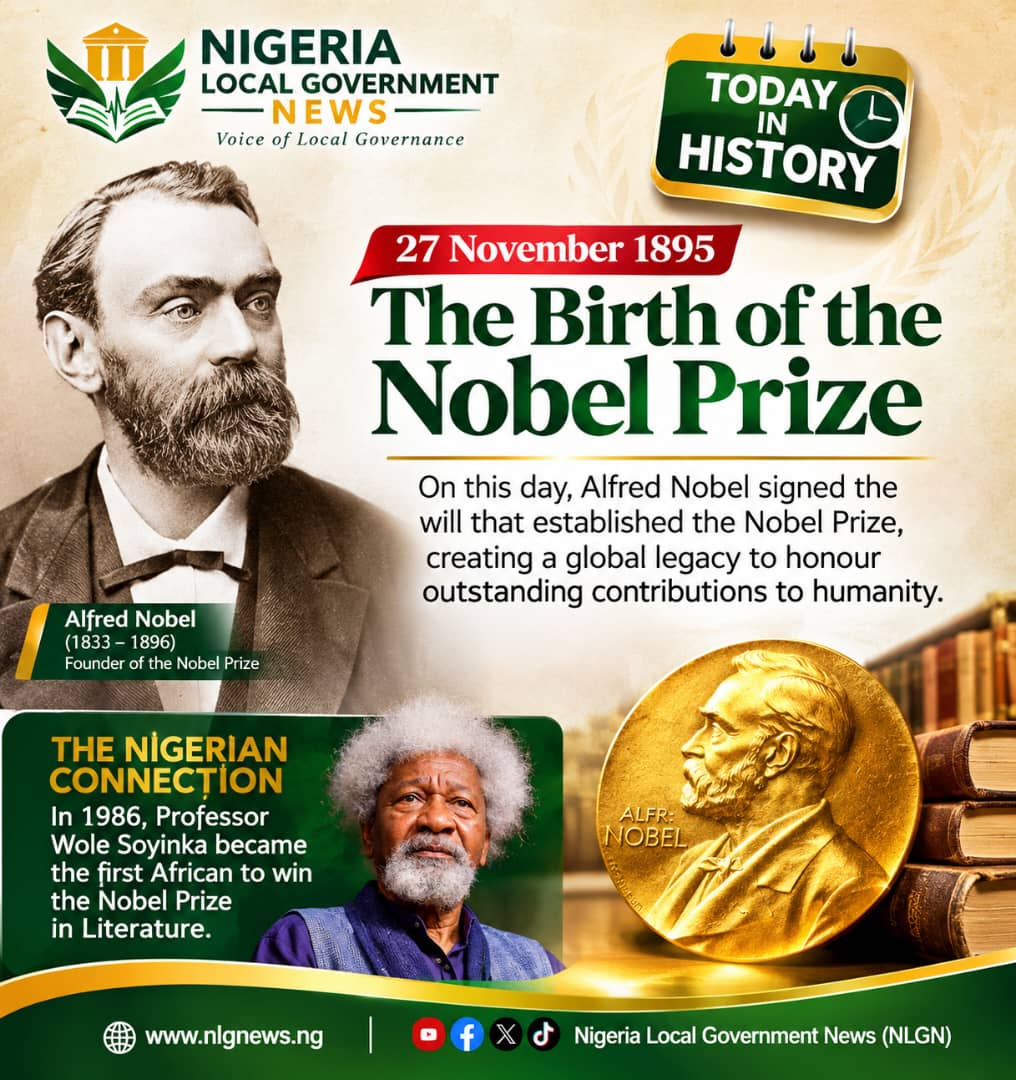
Today in History.
How one man’s decision to dedicate his wealth to humanity created an enduring global legacy.
On this day in 1895, exactly 131 years ago, Swedish inventor, industrialist and philanthropist Alfred Nobel signed his last will and testament in Paris, France, laying the foundation for what would become one of the world’s most prestigious honours — the Nobel Prize.
Nobel, famous for inventing dynamite, dedicated approximately 31 million Swedish kronor to rewarding exceptional contributions to humanity.
Rather than allowing his enormous fortune to disappear through generations of inheritance, he chose to invest in human excellence.
The first Nobel Prizes were awarded on 10 December 1901, in five original categories:
- Physics
- Chemistry
- Physiology or Medicine
- Literature
- Peace
The prize in Economic Sciences was established separately in 1968.
THE NIGERIAN CONNECTION
In 1986, Professor Wole Soyinka made history by becoming the first African to receive the Nobel Prize in Literature, demonstrating that intellectual excellence knows no geographical boundaries.
LESSONS FOR GRASSROOTS NIGERIA
Imagine if Nigeria’s wealthy individuals, industrialists and philanthropists deliberately established enduring endowment funds in their respective communities to promote:
- Educational excellence and scholarships.
- Agricultural innovation and food security.
- Scientific research and technological development.
- Entrepreneurship and youth empowerment.
- Community development and exceptional public service.
Imagine the transformational impact across Nigeria’s 774 local government areas.
Alfred Nobel died in 1896, but his wealth continues to inspire generations, stimulate innovation and celebrate extraordinary human achievements.
The greatest measure of wealth is not how much a man accumulates during his lifetime, but how much humanity continues to benefit long after he is gone.
Build institutions. Empower generations. Leave a legacy.
NIGERIA LOCAL GOVERNMENT NEWS (NLGN)
Voice of Local Governance
www.nlgnews.ng