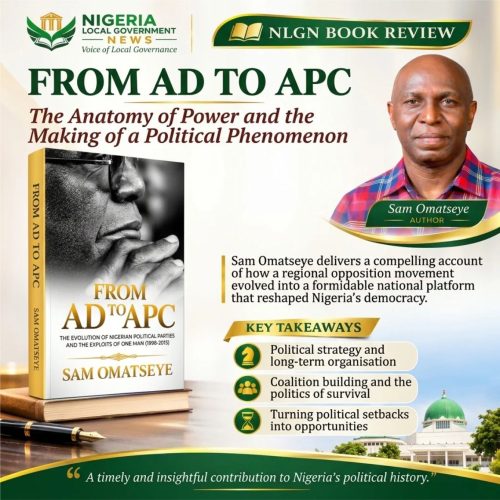
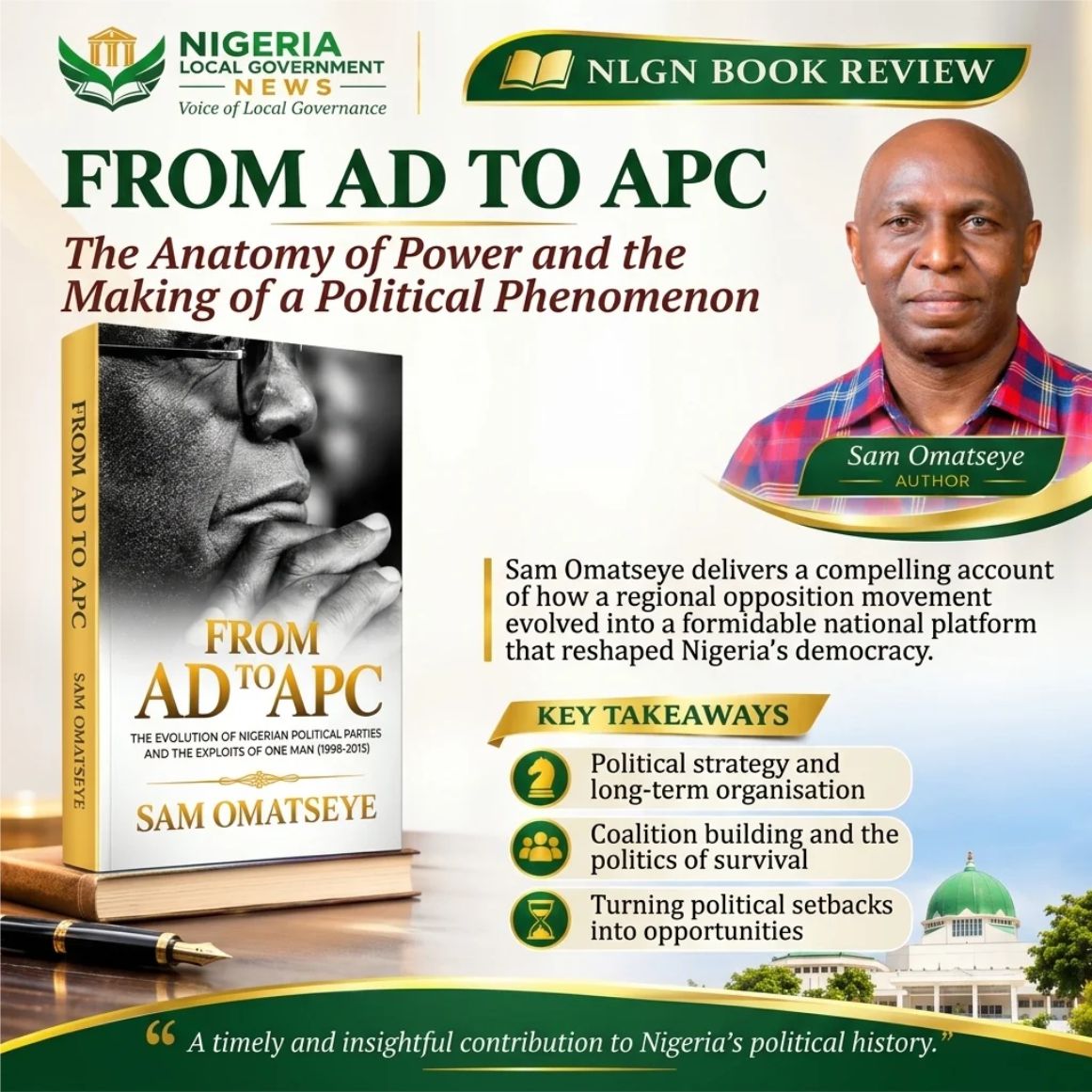
Sam Omatseye’s exploration of political strategy, opposition politics and the extraordinary journey that reshaped Nigeria’s democratic landscape.
- Book Title: From AD to APC
- Subtitle: The Evolution of Nigerian Political Parties and the Exploits of One Man (1998–2015)
- Author: Sam Omatseye
- Genre: Political History
Few developments in Nigeria’s contemporary political history are as fascinating as the transformation of a regional opposition movement into a formidable national political platform capable of dislodging an incumbent ruling party.
It is this remarkable period in Nigeria’s democratic evolution that provides the historical setting for Sam Omatseye’s From AD to APC.
Beyond the story of political parties, the book’s central subject invites reflection on ambition, strategic thinking, political survival, coalition building, patience and the pursuit of power.
From the ashes of AD to the corridors of federal power
Presented on November 24, 2026, at the State House, Abuja, the book revisits a defining chapter in Nigeria’s Fourth Republic, beginning with the aftermath of General Sani Abacha’s death in 1998 and culminating in Muhammadu Buhari’s historic electoral victory in 2015.
At the heart of this narrative is President Bola Ahmed Tinubu, whose political evolution from pro-democracy activist to Lagos State governor and subsequently a major architect of the APC occupies a central place in Omatseye’s account.
The political events of 2003 remain particularly instructive. While the Peoples Democratic Party swept five of the six South-West states previously controlled by the Alliance for Democracy, Tinubu retained Lagos.
What appeared to be the political humiliation of a regional movement would eventually become the foundation of a national political resurgence.
The progression from AD to Action Congress (AC), Action Congress of Nigeria (ACN) and ultimately the All Progressives Congress (APC) represents one of the most consequential political transformations in Nigeria’s democratic history.
The strategist and the politics of tomorrow
One compelling lesson emerging from the book’s subject is the distinction between winning elections and building enduring political structures.
While many politicians concentrate on the next election, Tinubu’s political trajectory illustrates the importance of cultivating relationships, developing successors, negotiating alliances and maintaining relevance beyond elected office.
Omatseye’s account invites readers to examine how political setbacks can become opportunities and how seemingly incompatible political interests can converge around a common objective.
For aspiring political leaders, the book offers material for studying the value of strategic patience, adaptability, negotiation and long-term political organisation.
Beyond Tinubu: The untold stories of Nigerian democracy
The book’s significance extends beyond the exploits of one individual.
Published assessments indicate that Omatseye revisits the NADECO struggle, the legacy of Chief M.K.O. Abiola, the controversies surrounding President Olusegun Obasanjo’s third-term agenda, the circumstances behind the emergence of Yemi Osinbajo as Buhari’s running mate and the negotiations that shaped the APC merger.
The author reportedly drew upon primary materials and interviews with at least 25 participants in the events. Perspectives from individuals across political divides, including Bode George and Chief Bisi Akande, enrich the historical narrative.
In a country where political history is frequently transmitted through rumours, partisan interpretations and selective recollections, the documentation of first-hand accounts is a worthy intellectual undertaking.
Between historical scholarship and political admiration
However, no serious assessment of From AD to APC should ignore the author’s publicly expressed admiration for Tinubu.
The central intellectual challenge is whether the celebration of an individual’s political ingenuity leaves sufficient room for a critical examination of his decisions, contradictions and shortcomings.
Political history must be more than the biography of its victors. It must also accommodate the experiences of their opponents, ordinary citizens and those whose contributions may have been overshadowed by more powerful personalities.
Indeed, prominent journalist Louis Odion, while commending the book’s historical value, has identified some factual and proofreading issues requiring correction in subsequent editions. Freelanews
Acknowledging such shortcomings does not diminish the importance of the publication. Rather, it reinforces the need for continuing research and historical scrutiny.
Lessons for grassroots political leadership
From the perspective of Nigeria Local Government News, perhaps the most relevant lesson is the importance of grassroots political organisation.
National political movements rarely emerge overnight. They grow through relationships established within communities, wards, local governments and constituencies.
However, the next frontier of Nigerian political evolution must go beyond building structures for electoral victories. Those structures must become instruments of sustainable development, economic empowerment, accountable governance and shared prosperity.
The true measure of political genius should ultimately be not merely the acquisition of power but the transformation of lives through its responsible exercise.
The NLGN verdict
Sam Omatseye’s From AD to APC is a timely contribution to Nigeria’s political literature, particularly as the country approaches another defining electoral season in 2027.
It deserves the attention of politicians, historians, journalists, political scientists, public administrators, students and anyone interested in understanding the mechanics of political power in Nigeria.
Readers need not agree with every interpretation to appreciate the importance of the historical undertaking.
Ultimately, the book provokes a fundamental question that transcends partisan loyalties:
If extraordinary strategic intelligence can be deployed to acquire political power, can that same intelligence be deployed with equal determination to eradicate poverty, strengthen institutions and transform Nigeria’s 774 local governments into centres of prosperity?
That is the next great political story Nigeria needs to write.
Winning power is a political achievement. Using power to transform society is a historical legacy.
NIGERIA LOCAL GOVERNMENT NEWS (NLGN)
Voice of Local Governance
www.nlgnews.ng