Remembering the people, places and defining moments that shaped Nigeria’s journey.
Today’s edition revisits an important chapter in Nigeria’s political history, with lessons about democracy, leadership and the power of the people.
33 YEARS AGO TODAY
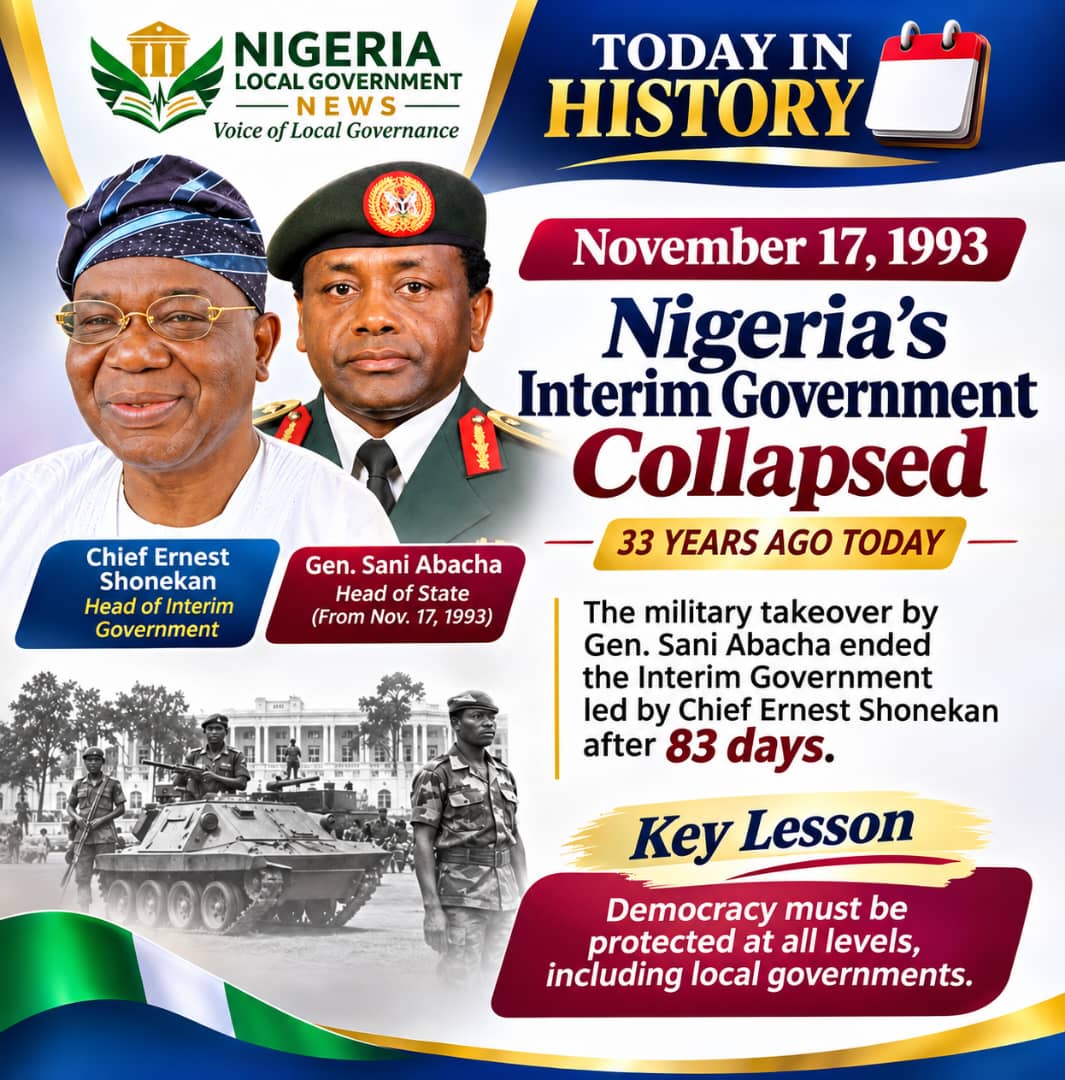
On this day in 1993, Nigeria witnessed another dramatic change in its political history as General Sani Abacha took power, bringing an abrupt end to the Interim National Government headed by Chief Ernest Shonekan.
It was a bloodless palace coup: Abacha, then Defence Minister in Shonekan’s own government, forced Shonekan to resign.
The Timeline
Date What Happened
12 June 1993 Presidential election held — widely believed to have been won by Chief M.K.O. Abiola
23 June 1993 General Ibrahim Babangida annuls the election, triggering nationwide crisis
26 August 1993 Babangida “steps aside.” Shonekan is sworn in as head of the Interim National Government (ING)
11 November 1993 Federal High Court in Abuja rules the ING was illegally constituted
17 November 1993 Abacha forces Shonekan to resign and becomes Head of State
Shonekan had assumed office on 26 August 1993, following the political crisis caused by the annulment of the historic June 12 presidential election.
His administration lasted just 83 days before Abacha assumed control on November 17 — the shortest tenure of any Nigerian Head of State.
Who Was Shonekan?
Born 9 May 1936 in Lagos, Ernest Adegunle Oladeinde Shonekan was a lawyer, businessman and former Chairman/CEO of the United African Company of Nigeria (UAC). He had earlier served as Head of the Transitional Council from 2 January 1993.
He was not elected. He was appointed by Babangida to manage a transition — but Abiola and many Nigerians never accepted the ING as legitimate.
In his short tenure, Shonekan released political prisoners detained by Babangida and introduced a bill to repeal three draconian military decrees. He also tried to schedule a fresh election, but strikes, protests and the court ruling overwhelmed his government.
He died on 11 January 2022, aged 85. He later founded the Nigerian Economic Summit Group (NESG) in 1994.
Did You Know?
The military takeover had direct consequences for grassroots democracy. The new regime dismantled the democratic structures elected during the transition to the Third Republic, dissolved elected political institutions, removed civilian state governors and disrupted local government administration across Nigeria.
Abacha ruled until his death on 8 June 1998, when he was succeeded by General Abdulsalami Abubakar, who eventually handed over to a civilian government in 1999.
The Lesson For Today
November 17 reminds Nigerians that democracy must be protected not only at the federal level but also in our states, local governments and communities.
A strong democracy begins with accountable leadership at the grassroots.
NIGERIA LOCAL GOVERNMENT NEWS (NLGN)
Voice of Local Governance
www.nlgnews.ng