
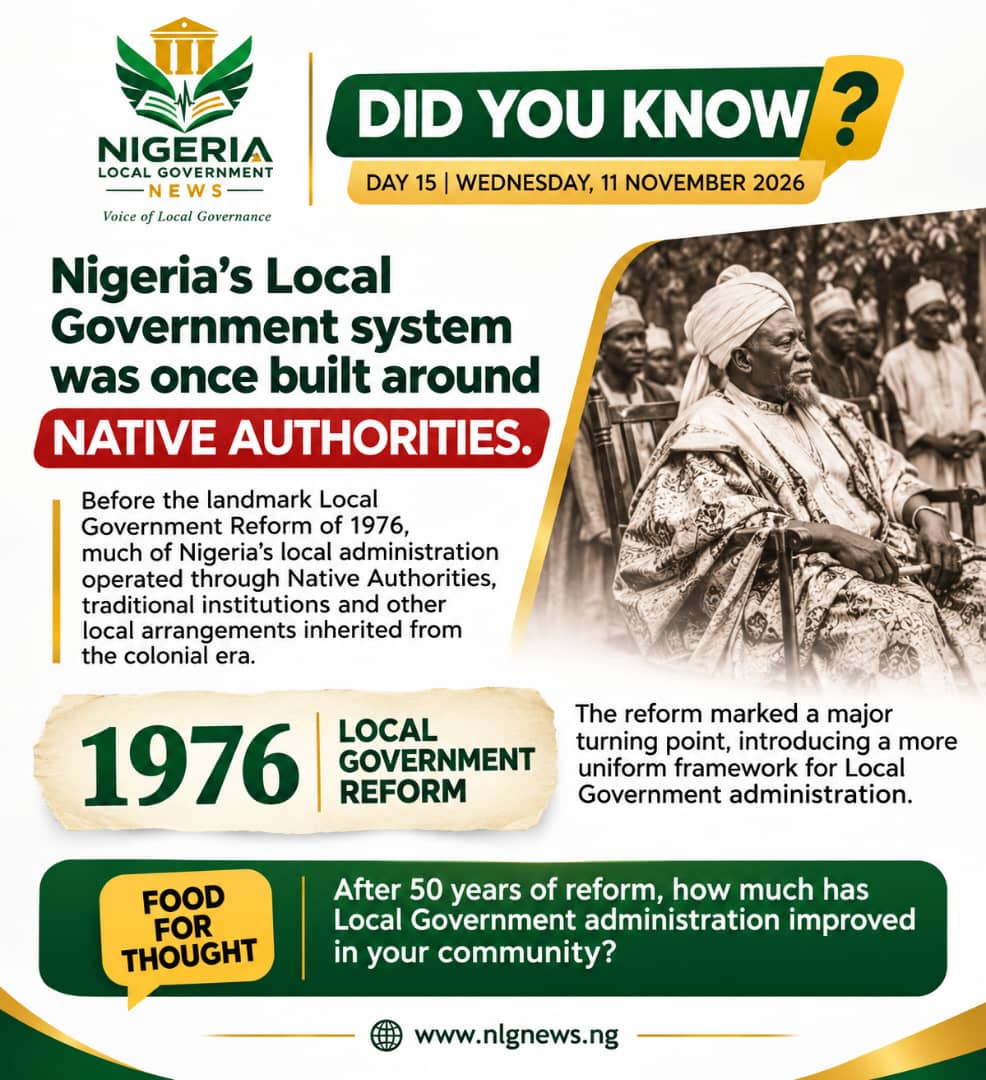
Before the landmark Local Government Reform of 1976, much of Nigeria’s local administration operated through Native Authorities, traditional institutions and other local administrative arrangements inherited from the colonial era.
The 1976 Local Government Reform marked a major turning point. It introduced a more uniform framework for Local Government administration and sought to establish Local Governments as a distinct tier of governance.
The reform laid important foundations for the constitutional recognition of Local Government councils in 1979.
WHY DOES THIS MATTER TODAY?
Because the struggle of 1976 is still our struggle in 2026.
- Local Government was meant to be a real tier of government — not an appendage of the state, not a department, not a political reward.
- Uniformity was meant to bring accountability. When every LGA operates by the same rules, it becomes easier to track funds, measure performance, and demand results.
- Grassroots development starts at the LGA. Roads, primary health centres, primary schools, markets, water — these are local government responsibilities. When LGAs are weak, communities suffer first.
- The 1976 Reform reminds us: Nigeria already knew 50 years ago that development cannot happen from Abuja alone. It must happen in the 774 LGAs.
That is why NLGN exists — to return attention, accountability and investment to where governance touches people first.
Local Government is not local politics. It is national development.
NLGN — Voice of Local Governance | http://www.nlgnews.ng
#NLGN #DidYouKnow #LocalGovernment #Nigeria #Grassroots
Voice of Local Governance
http://www.nlgnews.ng