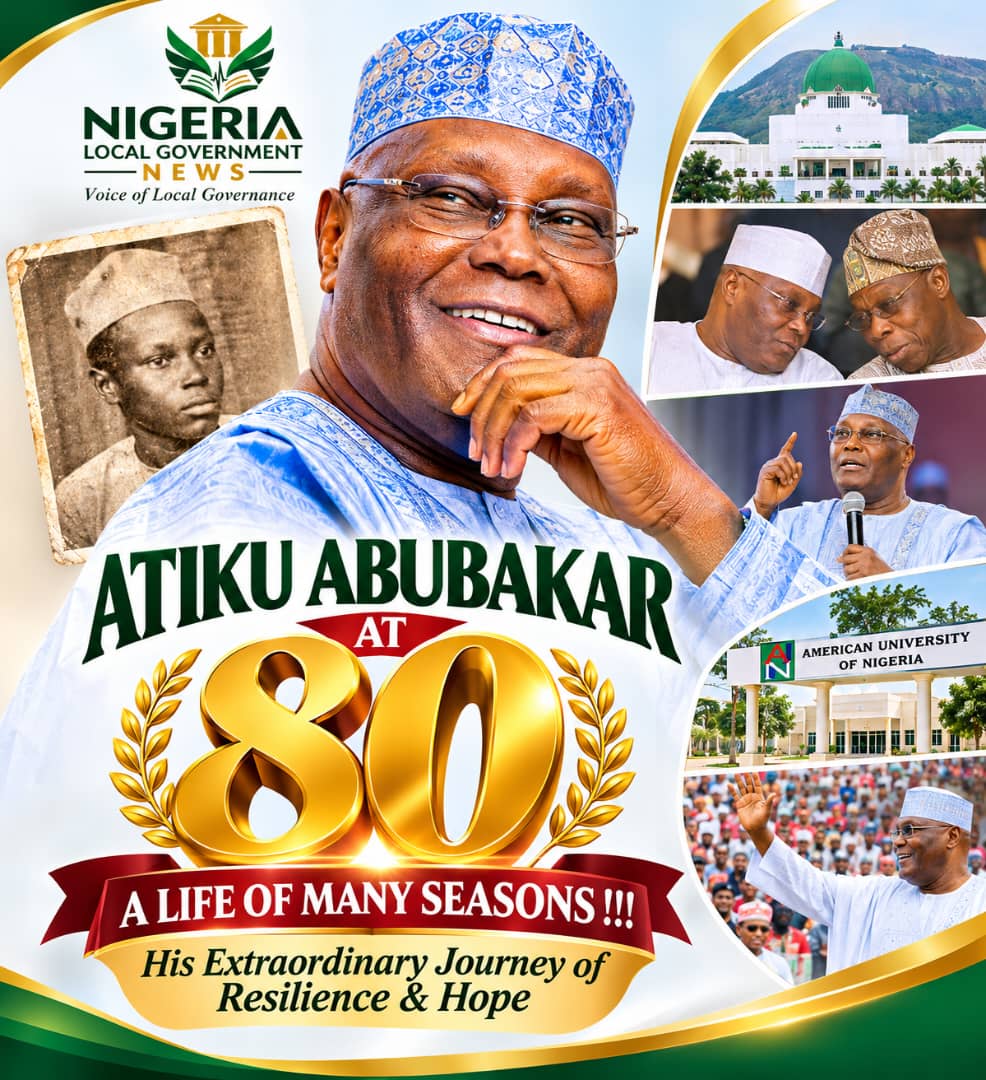
FROM A MOTHER’S MUD HOUSE TO THE ELUSIVE PRESIDENCY
The extraordinary journey of a village boy who became a wealthy entrepreneur, Vice President and one of Nigeria’s most persistent presidential aspirants — a life of triumphs, setbacks, political reinventions and unfinished ambitions.
NLGN SPECIAL BIRTHDAY FEATURE | 25 NOVEMBER 2026
There is something profoundly ironic about the life of Atiku Abubakar.
At 15, according to his autobiographical account, he bought his mother a house for nine pounds sterling. At 80, the one house that has remained beyond his reach is the presidential residence at Aso Rock, Abuja.
Between those two houses lies an extraordinary human story of poverty, education, enterprise, political power, broken alliances, courtroom battles, electoral disappointments and repeated returns to the political arena.
Few contemporary Nigerian politicians have experienced such a prolonged and eventful journey in the pursuit of the presidency.
Yet, to understand Atiku the politician, one must first understand Atiku the village boy.
The little boy from Jada
Born on 25 November 1946 in Jada, present-day Adamawa State, Atiku was the son of an itinerant trader, farmer and Islamic scholar.
His father initially resisted Western education, preferring that his son follow the family’s religious and occupational traditions. That resistance reportedly earned him a brief imprisonment under the compulsory education policy of the Native Authority.
The irony is that the very child whose father resisted Western schooling would eventually establish the American University of Nigeria in Yola.
Atiku lost his father during childhood. His mother, Aisha Kande, became one of the central figures in his upbringing.
At 15, while working as a holiday clerk at Ganye Native Authority under the then District Officer, Mallam Adamu Ciroma, he saved enough money to buy his mother a two-room mud bungalow with a thatched roof.
According to Atiku, his mother had lost her accommodation after her elder brother sold the family property without her knowledge.
Years later, when he became financially successful, he built her another house and reconstructed the original mud house.
It is a compelling human story of filial responsibility and the transformative power of economic opportunity.
Significantly, the institution that provided the teenage Atiku with his early employment opportunity was a local government authority.
The making of an entrepreneur
Atiku’s journey into wealth was neither entirely smooth nor free from controversy.
In 1974, while serving as a Customs officer, he obtained a federal staff housing loan of ₦31,000, which became the foundation of his property investments.
He reinvested his rental income, acquiring additional properties. He subsequently ventured into agriculture, but his large-scale farming enterprise collapsed in 1986.
His involvement in oil and gas logistics eventually brought considerable commercial success. However, his business interests during his Customs career also generated conflict-of-interest allegations that would follow him into politics.
Atiku maintained that he was not involved in the operational management of the logistics company.
His entrepreneurial history is consequently a story of opportunity, risk, setbacks, wealth creation and questions of public accountability.
The enduring political vicissitudes
Atiku’s political education was significantly influenced by his association with the late Major General Shehu Musa Yar’Adua and the political network that emerged around him.
His subsequent career reads like a chronicle of Nigeria’s modern democratic history.
Year – Political journey
1993- Contested the SDP presidential primaries before stepping down for MKO Abiola.
1998–1999 – Elected Governor of Adamawa State but became Olusegun Obasanjo’s running mate.
1999–2007 – Served as Vice President of Nigeria.
2007 – Contested the presidency under the Action Congress and lost.
2011- Lost the PDP presidential primary to Goodluck Jonathan.
2014 – Lost the APC presidential primary to Muhammadu Buhari.
2019 – Contested the presidency under the PDP and lost to Buhari.
2023 – Again contested under the PDP, finishing second behind Bola Tinubu.
2026 – Emerged as the ADC presidential candidate, subsequently encountering a court ruling invalidating his nomination.
Across more than three decades, Atiku has experienced the excitement of political victories, the disappointments of electoral defeats, the breakdown of friendships and the uncertainties of changing political alliances.
Perhaps his most dramatic political experience was his confrontation with President Olusegun Obasanjo during their second term in office.
The relationship that brought both men to power deteriorated into a bitter political struggle, particularly around the controversy over extending Obasanjo’s tenure.
Atiku survived attempts to prevent him from contesting the 2007 presidential election, but his eventual participation did not produce the presidency.
ATIKU AT 80: A political SWOT examination
An objective examination of Atiku’s political profile reveals several established assets, longstanding controversies and external challenges.
S — Strengths: Established political assets
- Political experience: Eight years as Vice President and decades of participation in national politics.
- Extensive political relationships: Connections developed across several political parties and geopolitical zones.
- Business experience: A substantial background in property development, logistics and private enterprise.
- Educational investments: His establishment of the American University of Nigeria represents a significant institutional contribution.
- Policy identity: Longstanding advocacy for restructuring, devolution of powers and private-sector-led economic development.
W — Weaknesses: Recurring political challenges
- Repeated party defections: His movement between political platforms has generated questions about ideological consistency and party loyalty.
- Historical controversies: Allegations surrounding his business dealings and privatisation responsibilities remain subjects of public scrutiny.
- Internal party disagreements: His presidential ambitions have repeatedly intersected with disputes over party leadership, zoning and political succession.
- Electoral record: Despite securing presidential nominations on several occasions, he has not won a presidential election.
- Generational debate: His milestone birthday has renewed public discussion about political succession and opportunities for younger leaders. Age alone, however, does not establish competence or fitness for office.
O — Opportunities: The changing national conversation
The issues surrounding the 2027 election include economic hardship, unemployment, insecurity, federalism, local government autonomy and the distribution of national resources.
Atiku’s longstanding policy positions on decentralisation and economic liberalisation form part of that conversation. His more recent commitment to revisit petrol subsidy policy also raises questions about affordability, fiscal sustainability and consistency with his previous economic positions.
The emergence of opposition coalitions provides another significant context for examining his political career and Nigeria’s multiparty democracy.
T — Threats: External political and institutional uncertainties
The immediate challenges surrounding his political future include:
- The legal dispute over the leadership of the ADC and the validity of his presidential nomination.
- Competition among opposition parties and political leaders.
- The organisational advantages of an incumbent governing party.
- Persistent disagreements over regional power rotation and political succession.
- The limited time available before the 2027 general election.
These are documented political circumstances, rather than predictions about the eventual election outcome.
At 80, another battle at the gates of power
There is an almost familiar pattern to Atiku’s latest political predicament.
On 5 November 2026, a Federal High Court invalidated the processes that produced the ADC leadership and his presidential nomination.
The ADC challenged the decision, while Atiku maintained that the litigation was an attempt to undermine his political movement.
Despite the controversy, THISDAY reported on 24 November that his party was preparing further campaign activities in Jigawa State for Friday, 27 November.
Campaign preparations, however, do not themselves resolve the legal status of his nomination.
In August 2026, Atiku publicly indicated that the 2027 election would be his final presidential race.
That declaration gives this milestone birthday an additional historical significance.
At 80, he confronts not merely another electoral contest but questions about the culmination of a political journey that began more than three decades ago.
Must a man become President to fulfil his destiny?
Perhaps the most profound question surrounding Atiku’s 80th birthday is whether attaining the presidency should be the ultimate measure of his life’s accomplishments.
He has occupied the second-highest political office in Nigeria, established businesses, invested in education, participated in democratic struggles and influenced national political conversations across several generations.
Yet, the presidency has remained an unfinished chapter.
His supporters may interpret his continued pursuit as a demonstration of perseverance. His critics may see it as an unwillingness to surrender personal ambition. Both perspectives form part of the public debate surrounding his political legacy.
History, however, has shown that the significance of a statesman need not depend exclusively on the office he ultimately occupies.
The grassroots lesson in Atiku’s story
For Nigeria Local Government News, perhaps the most important aspect of Atiku’s story remains the opportunity he received at the grassroots.
A local government institution gave a teenage boy employment. That employment enabled him to provide shelter for his mother.
Imagine what could happen if Nigeria’s 774 local government areas institutionalised holiday employment programmes, educational scholarships, vocational training, entrepreneurship development and mentorship schemes for deserving young people.
Somewhere in rural Nigeria today, there may be another talented child whose circumstances conceal enormous potential.
The difference between a lifetime of deprivation and a future of accomplishment could be one scholarship, one mentor or one opportunity.
Development begins when institutions recognise and nurture human potential.
The tale of two houses
Sixty-five years ago, a 15-year-old boy bought his mother a modest house in Ganye.
Today, that boy is 80.
He has experienced wealth and political power, tasted the sweetness of victory and endured the bitterness of defeat. He has made allies, lost allies, changed political platforms and repeatedly returned to the national political arena.
Whatever the future holds, the story of Atiku Abubakar cannot be reduced to the outcome of a presidential election.
It is also the story of a child who lifted his family above hardship, an entrepreneur who experienced success and failure, and a politician whose enduring ambitions have become intertwined with Nigeria’s democratic evolution.
The ultimate verdict on his political legacy belongs to history.
But between the little mud house in Ganye and the presidential residence at Aso Rock lies one of the most fascinating human and political journeys in contemporary Nigeria.
The first house was an expression of love. The second remains an expression of ambition. Between them lies the story of a lifetime.
NIGERIA LOCAL GOVERNMENT NEWS (NLGN)
Voice of Local Governance
www.nlgnews.ng