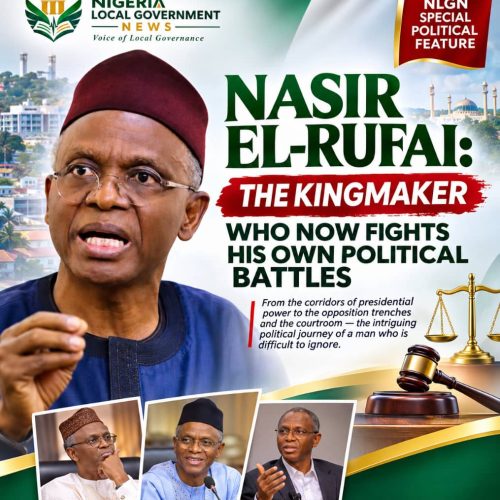
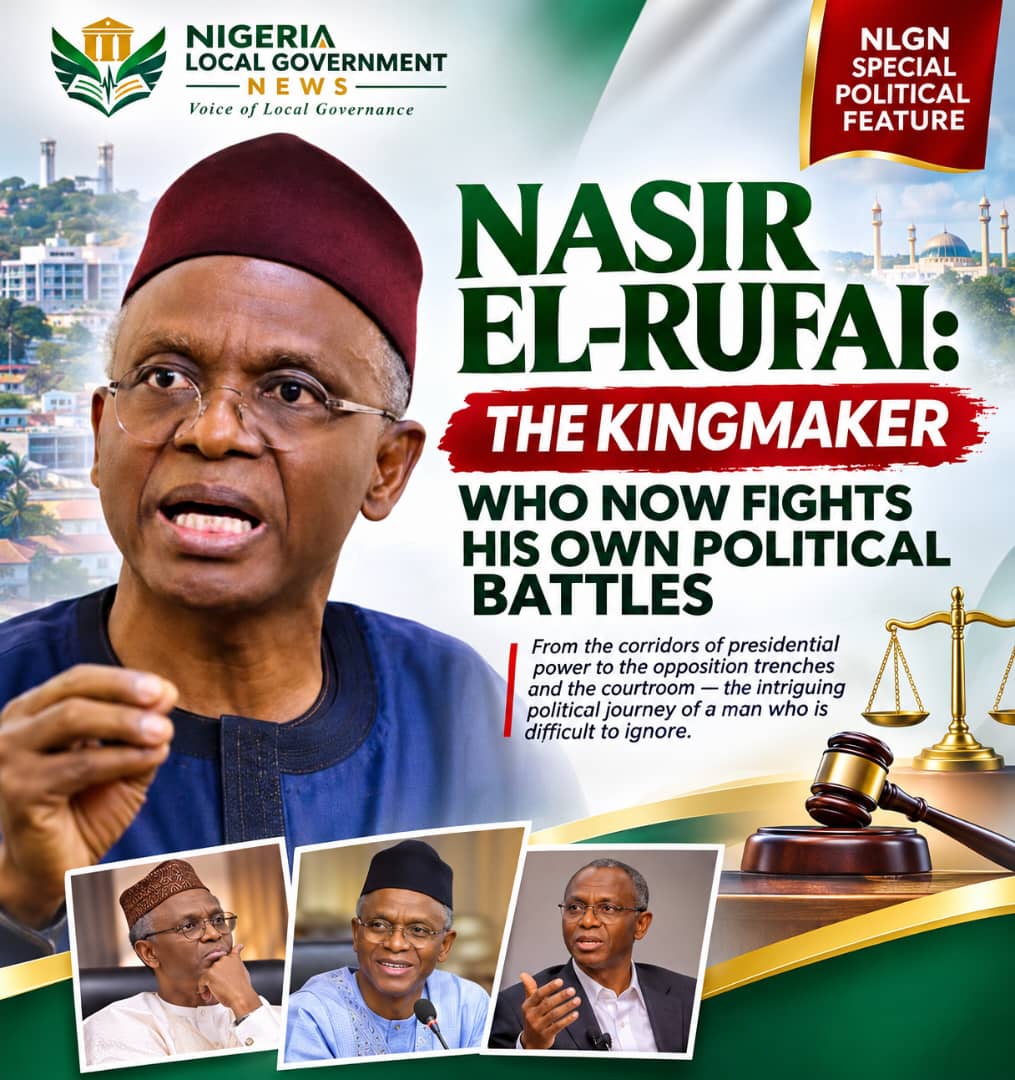
From the corridors of presidential power to the opposition trenches and the courtroom — the intriguing political journey of a man who is difficult to ignore, difficult to predict and difficult to appease.
There is something fascinating about Mallam Nasir Ahmad El-Rufai. His physical stature contrasts remarkably with the enormous political space he occupies in Nigeria’s contemporary history.
Love him or loathe him, El-Rufai is not a man whose presence goes unnoticed. His intellectual audacity, administrative courage, combative disposition and political unpredictability make him one of Nigeria’s most intriguing political personalities.
But perhaps the greatest irony of his political career is that a man who helped several others ascend to power now finds himself confronting the very political establishment he helped to build.
THE ACCIDENTAL PUBLIC SERVANT
Born on February 16, 1960, in Daura, Katsina State, El-Rufai rose from humble beginnings to become an accomplished quantity surveyor, technocrat, public administrator and influential politician.
From his days as Director-General of the Bureau of Public Enterprises to his tenure as Minister of the Federal Capital Territory under President Olusegun Obasanjo, El-Rufai cultivated a reputation for taking difficult decisions, sometimes without sufficient consideration for their political consequences.
His controversial demolition exercises in Abuja earned him admirers who saw him as a courageous reformer and critics who considered his methods excessively ruthless.
His autobiography, The Accidental Public Servant, captures something of the unconventional trajectory of his life.
Yet there appears to be very little accidental about his political calculations today.
THE KINGMAKER’S DILEMMA
El-Rufai was an influential figure in the political movement that brought Muhammadu Buhari to power in 2015. He subsequently became a prominent supporter of Bola Ahmed Tinubu’s presidential ambition in 2023.
His failure to secure ministerial confirmation in 2023 marked a significant turning point in his relationship with the ruling establishment.
The former political insider has since become a formidable critic of the government he helped bring into office.
In September 2026, he was named Deputy Chairman of Atiku Abubakar’s ADC National Campaign Council, placing him within the opposition’s preparations for the 2027 presidential election.
It is one of the enduring ironies of Nigerian politics: yesterday’s allies can become today’s adversaries without necessarily becoming tomorrow’s permanent enemies.
WHEN WORDS BECOME POLITICAL LIABILITIES
On Wednesday, November 25, 2026, El-Rufai appeared before the Federal High Court in Abuja, where he denied allegations of intercepting the telephone communications of National Security Adviser Nuhu Ribadu, describing his earlier televised remarks as political rhetoric and exaggeration.
The trial remains ongoing, and he has pleaded not guilty to the charges.
Beyond the legal questions, the development offers an important lesson in political communication: intellectual brilliance must be accompanied by verbal discipline.
Words that generate applause in a television studio may demand considerably more explanation in a courtroom.
Nevertheless, El-Rufai remains entitled to the presumption of innocence and a fair judicial process.
THE KADUNA PARADOX
As governor of Kaduna State between 2015 and 2023, El-Rufai demonstrated an appetite for ambitious reforms in infrastructure, education, urban renewal and public administration.
However, his administration also attracted criticism over mass dismissals, its approach to traditional institutions, communal relations and the management of insecurity.
His legacy illustrates a fundamental challenge of leadership: the difference between administrative efficiency and emotional intelligence in governance.
Development must not merely transform physical infrastructure; it must also inspire trust, strengthen social cohesion and protect human dignity.
Recent reports of defections by some of his former grassroots loyalists to the APC further underline the challenges confronting his political influence ahead of 2027. The numbers claimed by the defectors have not been independently established.
HIS GREATEST ASSET, HIS GREATEST LIABILITY
El-Rufai’s greatest political asset may also be his greatest vulnerability — his personality.
He is intellectually resourceful, articulate, experienced and courageous. Yet his confrontational style can make consensus-building difficult.
Politics rewards intelligence, but it also rewards patience, accommodation, diplomacy and the ability to preserve relationships even in disagreement.
The most successful political leaders are not necessarily those who win every argument, but those who know which arguments are worth winning.
2027: THE ULTIMATE TEST OF RELEVANCE
As Nigeria approaches another presidential election, El-Rufai faces perhaps one of the most consequential tests of his political career.
Can he translate intellectual influence into electoral influence?
Can he sustain grassroots loyalty outside the machinery of government?
Can he transform his opposition politics into a compelling alternative vision for ordinary Nigerians?
For the average citizen in Nigeria’s 774 local government areas, the ultimate concern is not who defeats whom politically, but who delivers security, affordable food, employment, quality education and prosperity.
That must remain the benchmark for El-Rufai and every other political heavyweight.
THE UNFINISHED CHAPTER
At 66, Nasir El-Rufai remains an intriguing figure in Nigeria’s evolving political landscape.
Whether history ultimately remembers him as a courageous reformer, a misunderstood intellectual, a controversial political strategist or a kingmaker whose ambitions became entangled in the complexities of power will depend substantially on how he navigates this latest chapter.
One thing, however, remains clear:
Power tests a man’s capacity to govern. The loss of power tests his character, resilience and political wisdom.
For Nasir El-Rufai, the second examination is now in progress.
NIGERIA LOCAL GOVERNMENT NEWS (NLGN)
Voice of Local Governance
www.nlgnews.ng