Beyond Popularity, Personality and the Politics of Journalism.
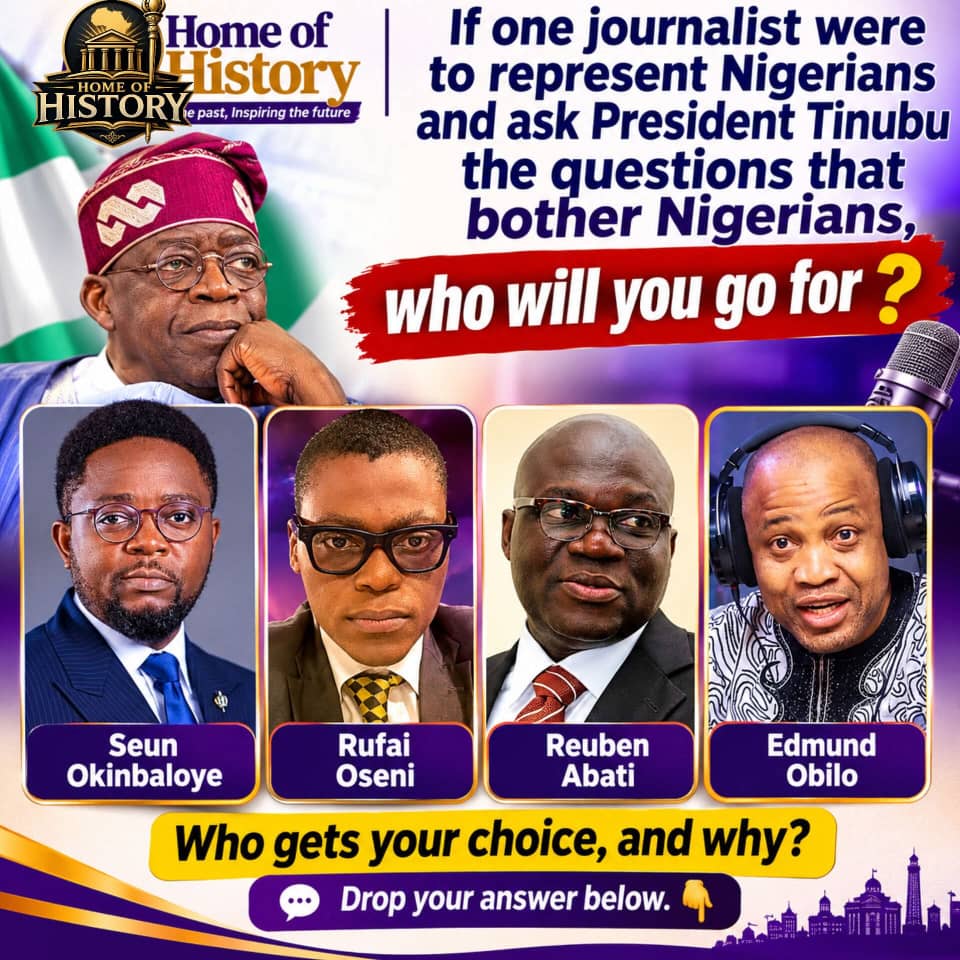
An interesting question posed by Home of History on social media has opened up a potentially important national conversation: If one journalist were chosen to represent Nigerians in an exclusive interview with President Bola Ahmed Tinubu, who should it be?
The four names presented are Seun Okinbaloye, Rufai Oseni, Reuben Abati and Edmund Obilo.
Beyond the social media popularity contest, however, lies a more fundamental question: What exactly do Nigerians want from journalism — confrontation, accountability, intellectual interrogation or meaningful answers to their everyday problems?
Each of these four broadcasters brings a distinctive professional temperament, interviewing philosophy and understanding of the Nigerian political environment.
Seun Okinbaloye: The strategic political interrogator
Seun represents a relatively balanced approach to political journalism. His strength lies in his composure, political intelligence and ability to navigate sensitive conversations without necessarily compromising the substance of an interview.
He understands the Nigerian political establishment and knows how to frame difficult questions within their broader political context.
His challenge would be ensuring that diplomatic questioning does not give the President room to avoid uncomfortable answers.
Rufai Oseni: The adversarial anchor and the fearless questioner
Rufai appeals particularly to audiences who desire aggressive scrutiny of political leadership. His directness, persistence and willingness to challenge official narratives have distinguished his interviewing style.
He would likely bring intensity and uncomfortable questions to a presidential interview.
However, assertiveness must not become an end in itself. The ultimate objective of journalism is not to defeat an interviewee but to extract information that serves the public interest.
Reuben Abati: The intellectual interrogator
Abati brings intellectual depth, historical consciousness, editorial experience and firsthand knowledge of presidential communication, having previously served as a presidential spokesman.
His understanding of governance and the internal workings of political power could enable him to interrogate presidential policies beyond their superficial presentation.
His greatest challenge would be demonstrating that familiarity with the establishment does not diminish the independence of his questioning.
Edmund Obilo: The unconventional intellectual
Obilo represents a distinctive tradition of broadcasting that combines philosophical inquiry, historical analysis, political intelligence and grassroots consciousness.
His interviewing style is often conversational but penetrating. He can transform seemingly simple questions into deeper examinations of leadership, governance and institutional responsibility.
His particular strength would be connecting presidential policies with the lived realities of ordinary Nigerians beyond Abuja and Lagos.
But what should Nigerians really be asking?
Rather than turning the exercise into a competition among journalists, Nigerians should be more concerned about the quality of questions put before their President.
- When will economic reforms translate into measurable improvements in household prosperity?
- What is the President’s assessment of the purchasing power of ordinary Nigerians?
- How can Nigerians independently measure the success of his administration?
- What practical steps are being taken to guarantee genuine local government autonomy?
- How is the government addressing unemployment, poverty and food insecurity?
- What mechanisms exist to ensure that increased government revenues translate into grassroots development?
- What specific commitments is the President prepared to make, with measurable timelines?
These are questions that transcend political affiliations, ethnic identities and religious sentiments.
The NLGN perspective
From the standpoint of development communication, Edmund Obilo would have a particularly compelling case, given the importance of connecting national policies with grassroots realities.
Nevertheless, an interview panel comprising all four journalists might ultimately serve Nigerians better, combining Seun’s political intelligence, Rufai’s assertiveness, Abati’s institutional knowledge and Obilo’s intellectual and grassroots perspective.
No single journalist possesses a monopoly on courage, intelligence or patriotism.
Furthermore, a presidential interview should neither become an exercise in political public relations nor a spectacle designed to humiliate the President.
It should be an opportunity for the President to explain, defend and account for his stewardship before the Nigerian people.
The greatest journalist is not necessarily the one who makes a President uncomfortable, but the one who makes a nation better informed.
Ultimately, democracy becomes stronger when leaders are accessible, journalists are independent and citizens are sufficiently informed to hold their government accountable.
Who gets your vote — Seun, Rufai, Abati or Obilo — and why?
NIGERIA LOCAL GOVERNMENT NEWS (NLGN)
Voice of Local Governance
www.nlgnews.ng