
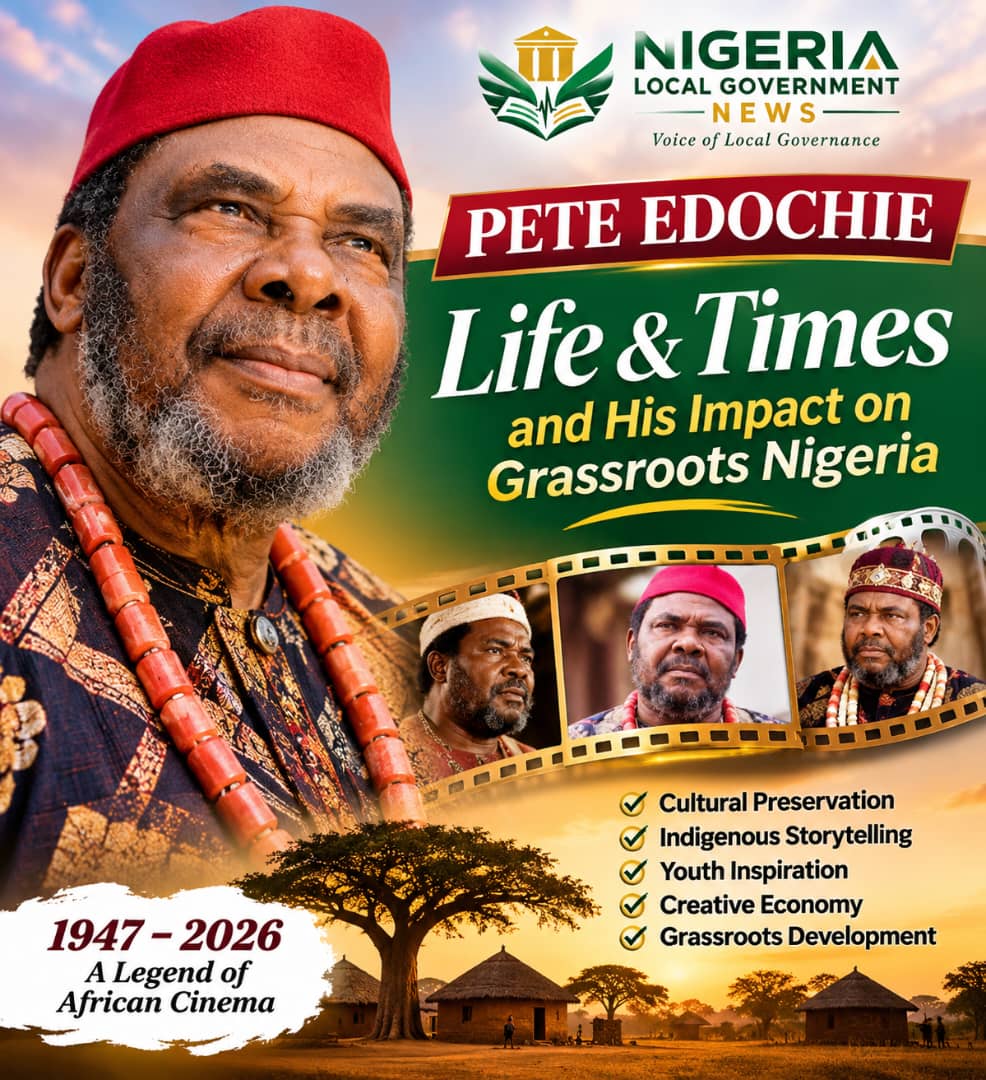
The man who turned African wisdom, culture and tradition into a global cinematic identity.
There are actors who entertain, actors who educate, and actors who become living symbols of their people’s cultural heritage. Chief Pete Edochie belongs to a remarkable generation of African entertainers whose influence transcends the television screen.
With his commanding voice, majestic appearance, philosophical expressions and extraordinary mastery of African proverbs, Edochie has become one of the most recognisable faces of African cinema.
His story is not merely about acting. It is about cultural preservation, indigenous storytelling, generational wisdom and the extraordinary power of entertainment as an instrument of grassroots development.
On Wednesday, 25 November 2026, Nigeria lost this distinguished cultural ambassador. According to a statement issued by his son, Leo Pete Edochie, on behalf of the family, the veteran actor passed away in Enugu at the age of 79, following a prolonged battle with prostate cancer.
An Igbo son raised in Northern Nigeria
Born on 7 March 1947 in Zaria, Kaduna State, Pete Edochie hailed from Akamnato, Ifite Nteje, in Oyi Local Government Area of Anambra State.
His upbringing in Northern Nigeria and ancestral roots in the South-East reflected the beauty of Nigeria’s multicultural identity.
He attended primary school in Zaria and St. John’s College, Kaduna, before pursuing professional training in broadcasting.
From the microphone to the movie screen
Before the fame, glamour and international recognition, Edochie was a career broadcaster.
He joined the Eastern Nigerian Broadcasting Corporation in 1967 as a junior programmes assistant, rising through the ranks to become Director of Programmes and Deputy Managing Director at the Anambra Broadcasting Service.
His journey demonstrated that professional excellence, patience and experience could become the foundations of an entirely new career.
The man who brought Okonkwo to life
His defining moment came in the 1980s when he portrayed Okonkwo in the television adaptation of Chinua Achebe’s celebrated novel, Things Fall Apart.
Edochie brought the complexities of traditional African society, masculinity, communal responsibility and cultural identity into millions of homes.
His performance attracted international attention even before Nollywood emerged as a globally recognised industry.
He subsequently featured in numerous productions, including Igodo, Rituals, Billionaire’s Club and Lionheart.
His enduring impact on grassroots Nigeria
1. Preservation of African cultural heritage
Through his films, Edochie helped preserve traditional attire, indigenous expressions, communal customs, traditional institutions and African philosophies for successive generations.
2. Making African proverbs fashionable
At a time when Western popular culture increasingly influenced younger Nigerians, Edochie made indigenous wisdom attractive. His delivery of proverbs became a cultural phenomenon that eventually found its way into social media and contemporary popular culture.
3. Giving visibility to rural communities
His films frequently portrayed village assemblies, traditional councils, ancestral compounds, festivals and communal relationships, bringing grassroots African experiences into mainstream entertainment.
4. Promoting the creative economy
As one of Nollywood’s pioneering personalities, Edochie contributed to the growth of an industry that generates livelihood opportunities for actors, costume designers, artisans, makeup artists, technicians, transporters and other small-scale entrepreneurs.
5. Inspiring young Nigerians
His transition from broadcasting to acting demonstrated that talent, discipline and cultural authenticity could provide pathways to national and international recognition, irrespective of one’s background.
6. Entertainment as development communication
His films often explored the consequences of greed, corruption, pride, betrayal, family disintegration and the abuse of traditional authority.
Beyond entertainment, these stories provided opportunities for public reflection on leadership, accountability and communal responsibility.
A nationally celebrated icon
Among his notable recognitions were:
- Member of the Order of the Niger (MON), conferred in 2003.
- Africa Magic Viewers’ Choice Awards Industry Merit Award in 2014.
- African Film Academy Lifetime Achievement Award.
- African Film Legend Award in 2020.
He was married to Josephine Edochie and blessed with six children, including actors Linc and Yul Edochie.
The challenge for Nigeria’s 774 local governments
Pete Edochie’s legacy presents an important development opportunity for Nigeria’s local government authorities.
Every community has stories waiting to be told, historical monuments waiting to be documented, indigenous languages deserving preservation and talented young people waiting to be discovered.
Local governments can honour his legacy by investing in community theatres, cultural festivals, filmmaking academies, indigenous language programmes, historical archives and grassroots talent discovery initiatives.
Culture must no longer be regarded merely as ceremonial entertainment. Properly harnessed, it can become an instrument of education, employment, tourism, social cohesion and economic prosperity.
The iroko may have fallen, but its seeds remain
Pete Edochie’s greatest accomplishment was not simply becoming famous.
It was demonstrating that an African could achieve global relevance without surrendering his cultural identity.
He made the village relevant, the elder fashionable, traditional attire prestigious and African wisdom internationally appreciated.
His voice may have fallen silent, but the wisdom it communicated will continue to resonate across generations.
Rest well, Chief Pete Edochie, MON.
1947–2026
The legendary Okonkwo. The custodian of African wisdom. The immortal cultural ambassador.
NIGERIA LOCAL GOVERNMENT NEWS (NLGN)
Voice of Local Governance
www.nlgnews.ng